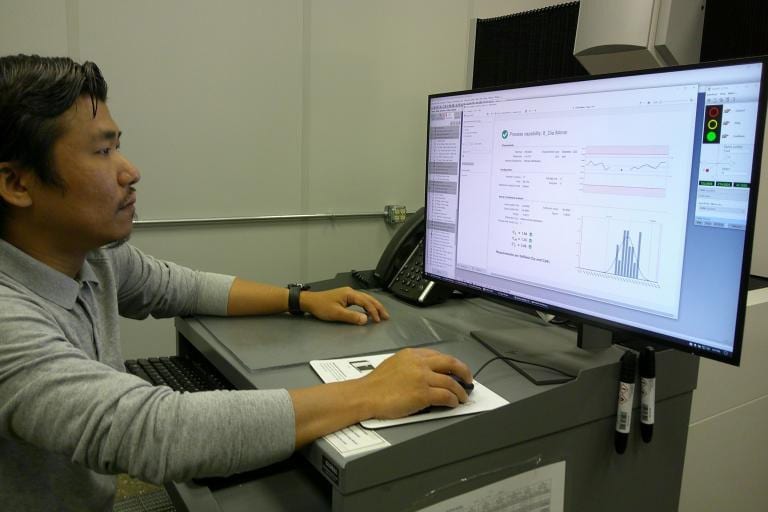
This Case Studies Special Advertising Section features manufacturing companies with real-world challenges using quality equipment, software and services to solve their problems and improve their processes. These problem-solving stories describe myriad manufacturing challenges and how the correct application of a supplier’s product or service made the difference, providing quantitative benefits to quality and manufacturing issues.
The suppliers in this special section present these real-world problems and solutions to help Quality Magazine subscribers who may have similar experiences.
Case Studies
— Special Advertising Section —
Trace Die Cast: Turning the skilled labor shortage into opportunity
Trace Die Cast (Trace) produces aluminum high-pressure die castings, primarily supplying tier-one and tier-two automotive OEMs. Its campus in Bowling Green, KY, houses machining and assembly operations and 44 diecast machines.
To grow throughout the years, the company had to withstand a challenging and changing economic environment.
"The availability of skilled labor in the manufacturing industry started to go down after the big market crash in 2009, and that affected us. So, in recent years, we’ve had to adapt. We realized we don’t need highly skilled engineers to make decisions on the shop floor; we just need people who come to work every day with a passion for what we do. We base our success on being able to train people from the bottom, teach them to understand the business, and make them successful," said Rodrigo Luis, VP of Quality at Trace Die Cast.
Prior to 2018, Trace Die Cast communicated quality data and information using reporting and SPC software. While these reports were sufficient for engineers, they were difficult for entry-level shop floor workers to understand. Luis and his team tried simplifying the reports themselves, but the process was lengthy, involving copying and pasting CMM data from hundreds of dimensions into Excel to produce a report. On average, this process would take three to five days.
A faster and more efficient way of communicating and reporting information was needed to empower workers. As a solution, Trace Die Cast purchased ZEISS PiWeb in 2018.

ATOM™ encoders allow rapid, high-accuracy flat-panel display (FPD) inspection and repair
TPC Motion (TPC), a well-known Korean manufacturer of motion-control components, has developed a laser aperture stop (optical slit) assembly that employs Renishaw's miniature ATOM encoder system. The aperture stop offers a compact and precise aperture-control solution for the laser repair of flat-panel display (FPD) assemblies and metal photomasks.

"The ATOM series meets all of our main requirements for a high-performance, low-noise and light weight miniature encoder system. Direct comparison with competing brands has demonstrated beyond doubt that ATOM is indeed best-in-class. Renishaw's delivery lead-times and after-sales support have also proven to be excellent.” (Mr. Hyun-Joo Hwang, Director of TPC Motion) In addition to the ATOM series, TPC employs Renishaw's TONiC™ optical encoder series and XL-80 laser interferometer for quality checks. Read the full case study and watch the video from the link below.

How Epicor ERP Can Help Manufacturers Automate Processes and Reduce Costs
Webster Industries is a make-to-order industrial equipment manufacturer headquartered in Tiffin, Ohio. An innovative leader in the engineered class chain, sprockets, and vibratory equipment markets, Webster manufactures high-quality, highly customizable solutions for material handling and power transmission applications.
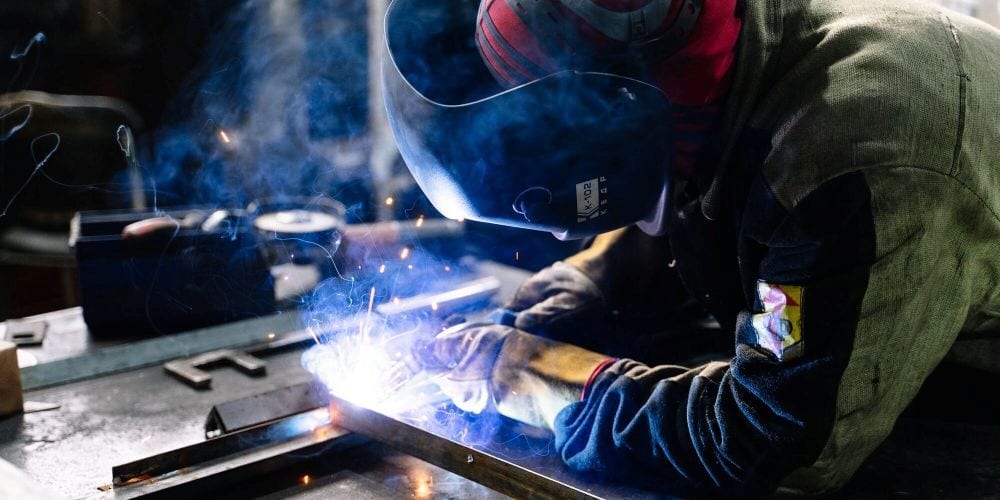
In 2017, Webster went live on Epicor ERP (now Kinetic), a system that’s provided the company with key capabilities to streamline processes. Today, more than half of Webster’s quotes and orders are generated via 11 different Epicor product configurators. Based upon user input, these configurators helped to enable on-the-fly order configuration by automatically creating bills of materials (BOM), routings, selling prices, and part numbers.
Webster also recently implemented the Epicor Maintenance module to automate production and facilities equipment maintenance. Armed with Advanced Material Management, Webster employees on the shop floor use mobile tablet devices to request materials and get complete inventory-level visibility—efficiencies that have also helped the company mitigate skilled labor shortages.
Company Name and Contact INfo
www.

Manufacturer Saves over $1,000,000/yr. with QI Macros
One aluminum manufacturer was having trouble with excess scrap. While there was significant, unavoidable startup scrap, other opportunities to reduce scrap became obvious after some analysis.
While many pounds of finished material were inspected and found wanting before shipment, roughly 40,000 pounds of finished metal was returned each month. Shipping and return costs ate into profitability. Finished metal cost about one dollar per pound. Returned metal had to be chopped up and fed back into the furnace for remanufacture.

Using QI Macros for Excel, it was possible to use PivotTables to analyze and chart ongoing scrap. Control charts showed a stable process producing consistent levels of monthly scrap. Drilling down into the data, Pareto charts showed that one machine out of many was producing most of the scrap. A few hours of root cause analysis with operators of that machine identified simple ways to reduce scrap just by changing the setup and ongoing adjustment process.
Annual savings amounted to over $1,000,000 after only a few hours of analysis.
Million-dollar opportunities lay hidden in data about defects, mistakes, errors, scrap, waste and rework. Using Excel and QI Macros it is possible to mine and find those opportunities—the invisible low-hanging fruit in any company. QI Macros Improvement Project Wizard automates this analysis, creating improvement projects in just minutes.
This analysis works in manufacturing, healthcare, telephony, banking and any industry that tracks waste and rework. Haven’t you waited long enough to find your hidden, low-hanging fruit?
Providing value creation guidance to NDE professionals worldwide to help them create and mature their own Use Cases for a Conformable DR Detector
Context of the solution
Radiographic image formation principles advise that, whenever feasible, the distance between the subject and the recording media, regardless of whether it is film, IPs, or DDAs, should be maintained as minimal as it is possible to minimize distortion and unsharpness effects on the resulting image.
This image formation principle is replicated in the radiographic inspection requirements contained within an ample spectrum of manufacturing and construction codes worldwide. Codes such as the ASME BPVC for boilers and pressure vessels or AWS D1.1/D1.1M in steel construction, specifications such as API 6A and standards such as ASME B31.1, ASME B31.3 or API 1104 have as a common trait that they embrace this imaging principle not only for the inspection of welds on pipes or tubular components, but also integrate it in the radiographic inspection requirements for castings, rolled products, forges, pipes, tubing, or other manufactured components formed with rounded surfaces.
Description of the initiative
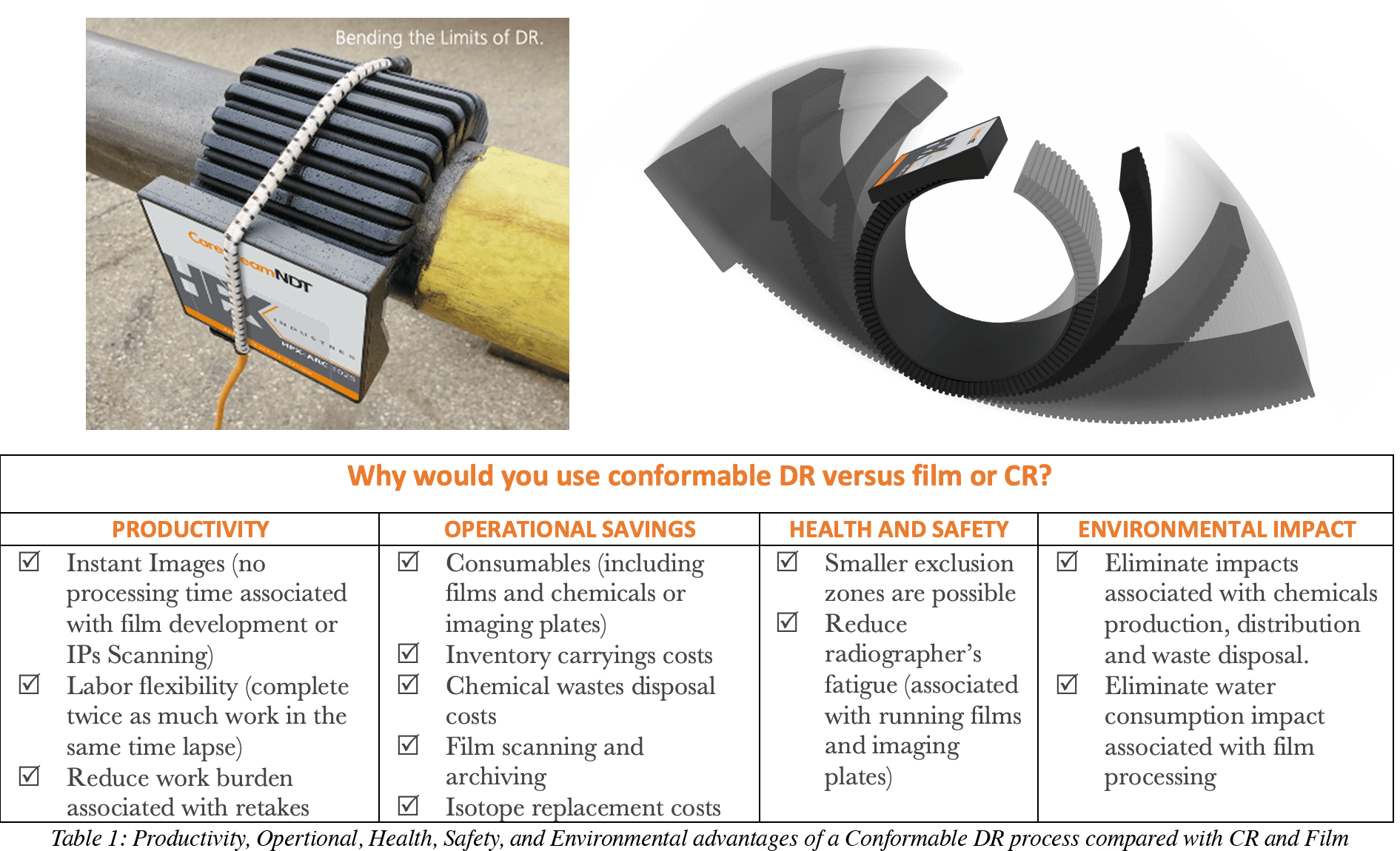
Bendable Digital Radiography Detectors constitute a new, exciting product category that delivers high-resolution images for these rounded components at game-changing speed and certainty in industries such as Oil & Gas, Energy Generation, Aerospace, Transportation, Military and Defense or NDE Services, which should capitalize on their inherent advantages as described in the following table:
In order to facilitate the creation of customized use cases for specific industries and imaging applications, Carestream NDT created a series of guidance documents that merge the hands-on field experience of its product specialists with the vast knowledge of its NDE imaging researchers.
Results Obtained - The Why’s, How’s and What’s
These guidance documents took the form of a series of three white papers with a profound strategic approach that adapts the structure of Simon Sinek’s Golden Circle:
Part I – “The Why’s”: Expanding, Enriching, and Reinforcing Your Imaging Capabilities
Part II – “The How’s”: Proposing an actionable approach to a new set of imaging capabilities
Part III – “The What’s”: An Instructive Comparison of Conformable DDAs to Film and CR Imaging Plates
This series of three whitepapers is available to download at our website.
