Robots
Vision & Sensors
V&S
H2 Deck By Bold Name
h2 xxxxxx
H1 xxxxxx
h2 xxxxx

Visual SLAM (Simultaneous Localization and Mapping) is an AI-driven, 3D vision-based method that marks a departure from conventional navigation systems. By Alex Miller
Visual SLAM Transforms Navigation for Autonomous Mobile Robots (AMRs)
Autonomous Mobile Robots (AMRs) are cutting-edge transport robots specifically designed to move loads autonomously in a diverse range of industries, from automotive to logistics to consumer goods and other industrial processes.
In addition to significantly boosting productivity in factories and warehouses by autonomously moving raw materials, parts, or finished goods between workstations or storage areas, AMRs handle tedious, non-value-added tasks like cart pushing, allowing human employees to focus on higher-skill activities.
The nature of the tasks AMRs typically handle include:
- Inbound logistics: Moving goods from receiving to storage.
- Line-side delivery: Delivering parts to assembly lines.
- Order picking and packing: Supporting fulfillment by bringing items to human pickers (or vice versa).
- Finished goods transport: Moving completed products to shipping areas.
AMRs come in various forms that move products in different ways, such as “Tugs” that tow wheeled carts, trailers or trolleys; “Movers” that carry materials on pallets or large containers on their top surface: and “Fork-Lift” type vehicles that move pallets or containers with front-loaded tongs.
The New Frontier: Visual SLAM Navigation
As the demands for flexibility, efficiency, and intelligence in internal logistics systems grow, the capabilities of AMRs must evolve in tandem. The evolution of AMRs has reached a pivotal point with the introduction of groundbreaking navigation technologies. Among the most transformative is Visual SLAM (Simultaneous Localization and Mapping)—an AI-driven, 3D vision-based method that marks a departure from conventional navigation systems.
Unlike traditional methods like magnetic tape, QR codes, or 2D LiDAR-based SLAM, Visual SLAM requires no added infrastructure. Instead, it uses off-the-shelf cameras mounted on AMRs to perceive natural features in the environment, construct real-time 3D maps, and determine positioning with accuracy down to ±3 mm

This ability to see and understand the environment fundamentally changes how AMRs operate. Visual SLAM recognizes fixed elements such as floors, ceilings, and walls while intelligently ignoring transient objects like humans or vehicles. This capability allows robots to make context-aware decisions — selecting optimal paths, avoiding obstacles, and adapting to changes in real-time.
In manufacturing or logistics centers where layouts frequently evolve, the ability of Visual SLAM to auto-update maps and synchronize them across the AMR fleet enables consistent performance without production downtime or reprogramming, typically resulting in a 20% reduction in commissioning time compared to 2D SLAM systems.
“The introduction of Visual SLAM navigation for AMRs radically enhances companies’ operations, making them faster, more efficient and more flexible, while freeing up employees to take on more rewarding work,” said Marc Segura, president of ABB Robotics Division. “Offering more autonomy and intelligence, AMRs can operate safely in dynamic, human-populated environments. Visual SLAM technology provides a new level of intelligence for AMRs that transforms robotic applications, from manufacturing, logistics and beyond.”
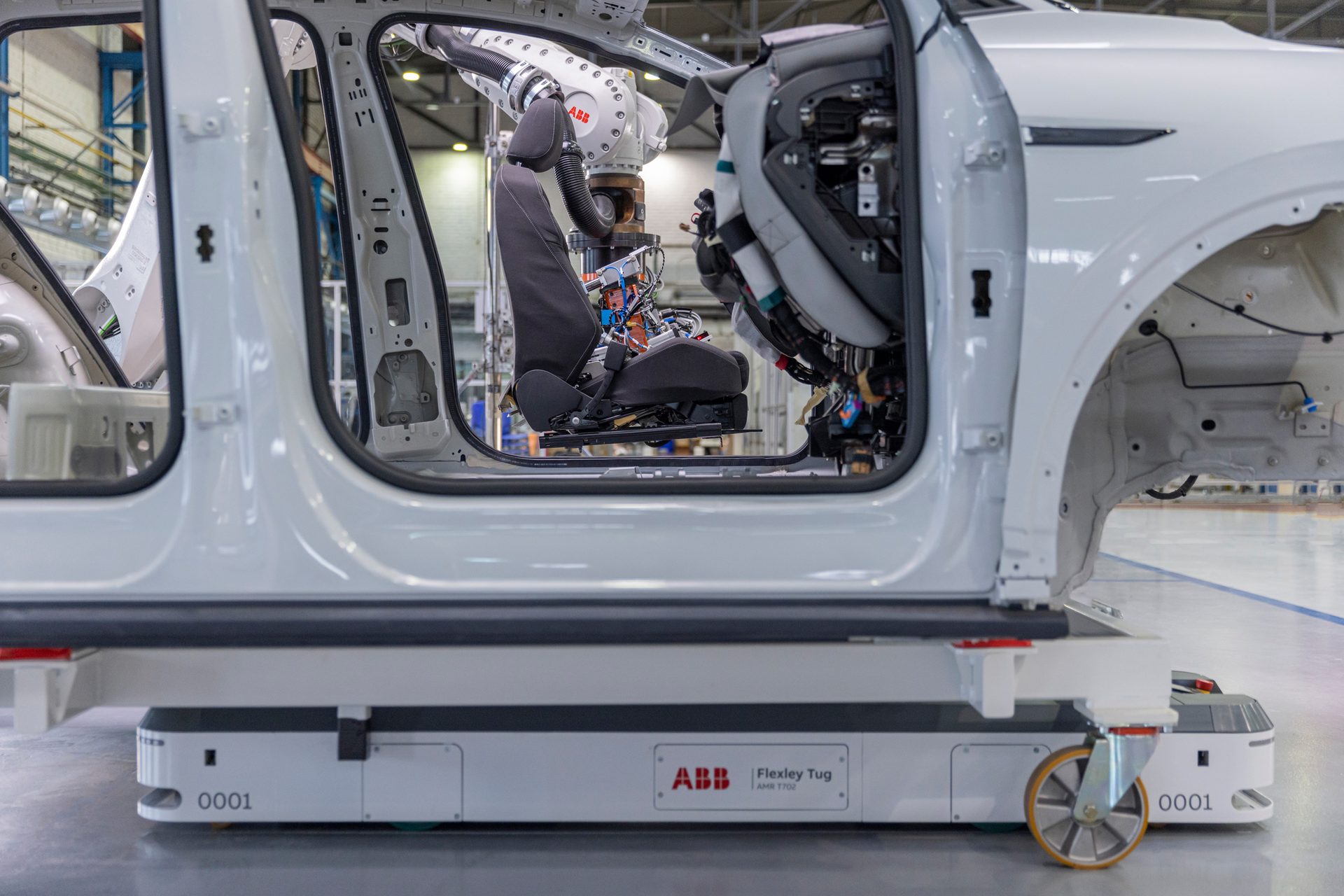
In automotive production, Visual SLAM is helping to phase out fixed conveyor lines in favor of modular production cells served by intelligent AMRs.
Enhanced Fleet Management with Simulation Programming Software
At least one leading AMR OEM offers a simulation software that complements Visual SLAM with a programming suite that dramatically simplifies the setup, operation, and management of AMR fleets. Designed to offer full autonomy and flexibility, the software allows users to
- Map environments through intuitive visual tools,
- Define missions and paths without the need for coding,
- Manage traffic and orders with intelligent assignment algorithms,
- Monitor performance in real-time with comprehensive data dashboards.
The platform’s intuitive interface empowers operators to make layout changes, update tasks, and manage the fleet without external support or programming expertise. Built-in automation tools reduce setup errors and commissioning time by up to 20%.
The powerful software also features a server-based Fleet Manager that orchestrates multiple AMRs simultaneously, assigning optimal tasks and ensuring smooth traffic flow. Its open API architecture also allows seamless integration with third-party systems, enhancing operational interoperability across the enterprise.
This software-centric approach empowers even non-expert users to adapt their fleets to changing business requirements, reducing dependency on external technical support and minimizing the risk of errors during deployment.
Strategic Benefits of Visual SLAM and Simulation Programming Software
The integration of Visual SLAM and the accompanying software deliver a range of strategic advantages:
- No Infrastructure Changes Needed: Eliminates the costs and limitations associated with physical markers or reflectors.
- Faster Deployment: Commissioning is up to 20% quicker, reducing downtime and speeding ROI.
- Higher Accuracy and Safety: Positioning to within ±3 mm enhances performance in tight or sensitive operations.
- Fleet Scalability: Centralized map and mission sharing allow updates to be propagated across the entire robot fleet instantly.
- Robustness: Operates reliably despite vibrations, lighting changes, or partial occlusion.
- Security: Visual SLAM processes raw sensor data only — no images are saved, maintaining privacy and compliance.
Moreover, these systems can withstand the environmental unpredictability common in logistics and manufacturing centers, making them especially useful for high-mix, low-volume operations and just-in-time supply chains.
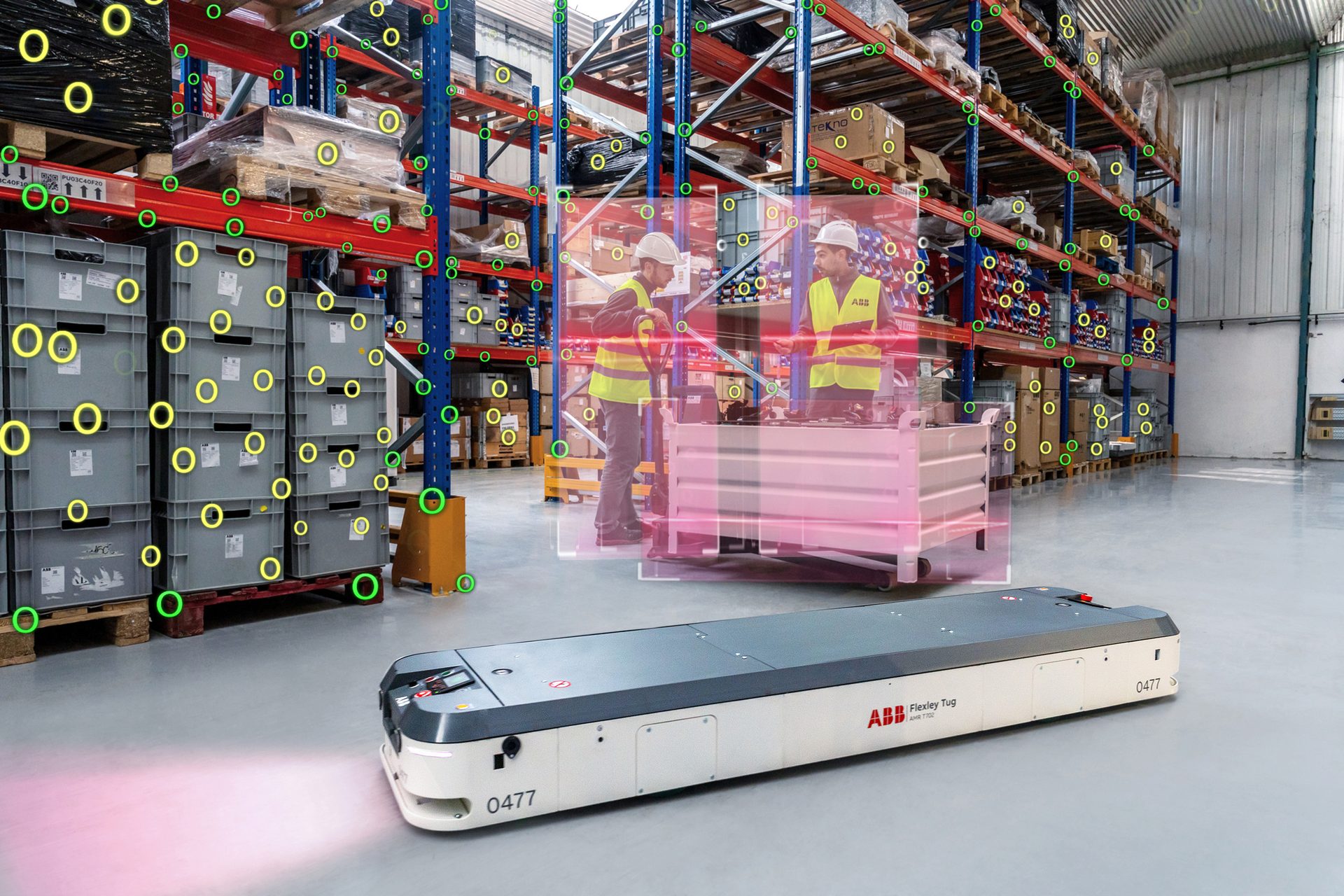
AMRs with Visual SLAM navigation technology use AI and 3D vision to perceive natural features in their environment, allowing them to make intelligent routing decisions based on their surroundings.
Industry Impact and Adoption
Visual SLAM technology is already being deployed in live industrial projects in the automotive and E-commerce sectors. In automotive production, Visual SLAM is helping to phase out fixed conveyor lines in favor of modular production cells served by intelligent AMRs. In E-Commerce and logistics, the ability to adapt to fast-paced environments enables real-time order fulfillment and inventory handling with greater accuracy.
Consumer goods manufacturers are also embracing the solution, drawn by its traceability features and its ability to ensure safe handling in environments where hygiene and accuracy are paramount — such as in pharmaceuticals and cosmetics.
“This combination of mobile robotics and leading AI-powered navigation technology brings unmatched intralogistics flexibility and scalability in end-user environments that are shifting from linear production to dynamic manufacturing networks,” said Segura. “AMRs with Visual SLAM are a perfect match for a wide range of industries, such as automotive, consumer goods sector or logistics, especially in large, busy warehouses and fulfilment centers where the environment is constantly changing.”
The Collaborative Future of Robotics
The AMR programming and navigation advancements represent a larger trend in industrial automation: the convergence of AI, machine vision, and easy-to-use software to create robots that are not only autonomous but collaborative, secure, and user-friendly. These technologies reduce reliance on human intervention for mundane and hazardous tasks, creating safer and more engaging roles for workers while enhancing overall operational efficiency.
By removing the constraints of physical infrastructure, reducing deployment complexity, and enabling AI-powered navigation and management, these innovations offer a compelling vision for the future of automation — one that is flexible, intelligent, and deeply human-centric.
As a result, businesses of all sizes will have increasing access to scalable, intelligent automation solutions designed to grow alongside their needs.