Aerospace Column
John Vandenbemden
Aerospace Column | Francois Gau
Beyond the Quote: Why Quality Is Your Most Valuable Sourcing Strategy.
Put Quality First: The Case for Rethinking How We Choose Manufacturing Partners

In today’s fast-paced, precision-driven manufacturing world, how we approach quality isn’t just a compliance concern—it’s a strategic advantage.
Yet too often, buyers make critical sourcing decisions based on longtime relationships, certification checkboxes, or approved vendor lists. While these criteria offer a sense of control, they can mask deeper questions, such as:
- Who can make this part to these tolerances at a reasonable total cost?
- How do you really know—who can help?
- And how well are you communicating your true quality expectations?
A common pitfall is choosing vendors because they’re familiar. They’re on the approved list. They have the certifications. They haven’t caused major issues — yet. But this logic can trap your organization in a cycle of average performance, blind trust, and suboptimal outcomes.
Having worked with hundreds of manufacturers, from nimble shops to multinational powerhouses across the aerospace, automotive, energy, and medical industries, one truth stands out:
Manufacturing quality must be at the center of every business decision, including the purchasing of parts and assemblies.

Caption

The standard provides a systematic approach to sampling without overtaxing resources.
Manufacturing quality isn’t just about what happens on the shop floor. It begins with quoting. Every request for quote (RFQ) is packed with challenges: tight tolerances, flow-down requirements, and critical details buried in 2D prints, 3D models or attached/linked PDFs.
When specifications are misinterpreted, misunderstood, or overlooked, the consequences ripple through production: Parts need rework. Deliveries are delayed. Customers are frustrated. Revenue may be lost... As such, the direct and indirect costs of quality skyrockets.
Increasingly, I see this phenomenon as a business problem instead of a technical issue. In an era when 3D modeling is becoming the norm and standards remain fragmented, it’s on buyers and manufacturers alike to close the interpretation gap.
As a buyer or OEM, your responsibility doesn’t end with issuing the RFQ. Sharing clear, complete, and current information with suppliers is equally critical. To help determine your information’s usefulness, ask yourself these questions:
- Are you making assumptions that your vendors should know?
- Are your revision histories clear?
- Have you built an efficient system to communicate engineering and quality specifications?
This isn't the future.
It's today's best practice.
Technologies for sharing complex, confidential, and often restricted part files (2D and increasingly 3D) and associated specifications and requirements have existed for years.
The core quality-related issues at the buyer level are the time consuming, manual, and interpretation processes related to:
- Gathering data from a reliable, real-time, source. Revision control is often an issue.
- Sending an RFQ package only to those proven capable of doing the work flawlessly.
At the manufacturer level, the issues are almost reversed: Can we make that part? With these requirements? That means:
- Having tools and systems to “balloon” parts fast and ID critical features
- Identify quality data gap or risks and gather prior quality data on similar parts.
- Able to share quality data and documents in quasi real time, before, during, and after a part is made.
These activities consume significant resources and can result in misinterpretations and manual data re-entry in multiple systems. Most of us still use paper and pencil, Excel spreadsheets, antiquated quality management systems, ERPs, CMMs, customer portals and more.
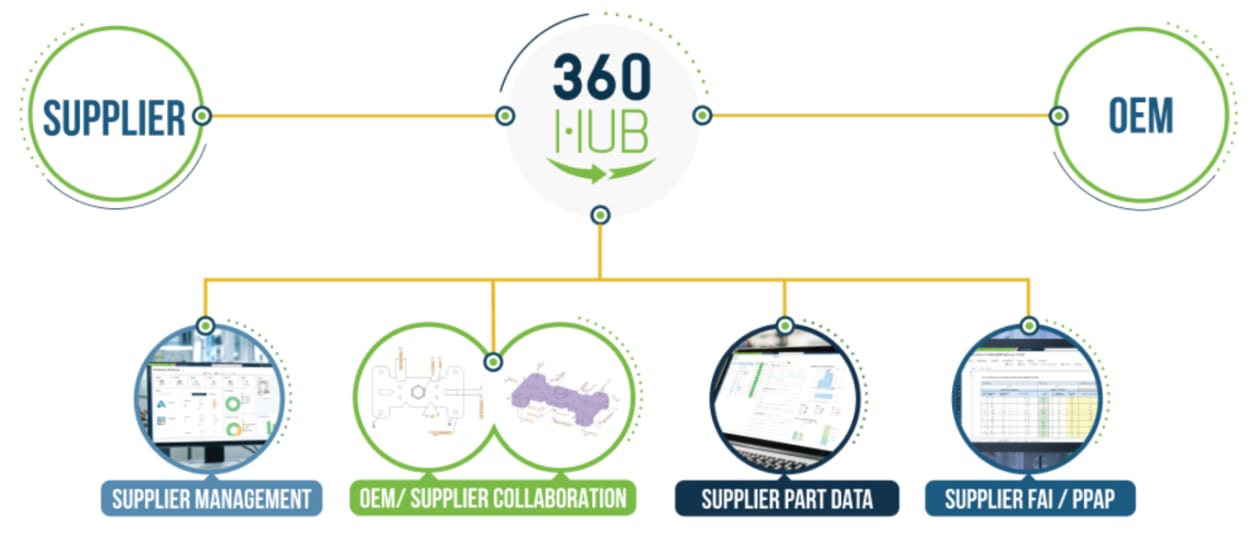
Advanced quality manufacturing systems allow engineers to use a single database, to balloon parts from prints or 2D and 3D models, extract valuable GD&T data, create inspection workflows, collect and analyze real-time inspection data, and create centralized reports. This system also connects buyers and manufacturers in real time with easy workflows and sign-off protocols.
These systems are digital threads that connect buyers and manufacturers to facilitate quoting and reporting.
In the infographic below, courtesy of High QA, the idea is to leverage advanced tools to enable collaboration centered around manufacturing quality:
Source: High QA
This isn’t the future. It’s today’s best practice.
In summary, your RFQs should clearly communicate expectations, and you should choose your vendors based on their proven capabilities instead of on price or familiarity.
The next time you review your AVL, prepare an RFQ, or consider sourcing a new part, ask yourself:
- Have we defined success clearly?
- Do we know who can meet these specs, at this cost?
- Are we choosing partners who make quality a cornerstone instead of a checkbox?
Stop settling for “good enough” and start building something better by using the best quality management information technology can provide.