xxxxxx xx
xxxxxxxxxx
Training
NDT
NDT
Manufacturers and training providers are overhauling how they prepare nondestructive testing inspectors. New imaging technology, AI, simulation software and changing standards are reshaping training programs, while leaders are expanding their outreach and even changing their organizations’ internal cultures to attract and retain a new generation of inspectors. By Genevieve Diesing
Rethinking NDT Training for a Changing Industry
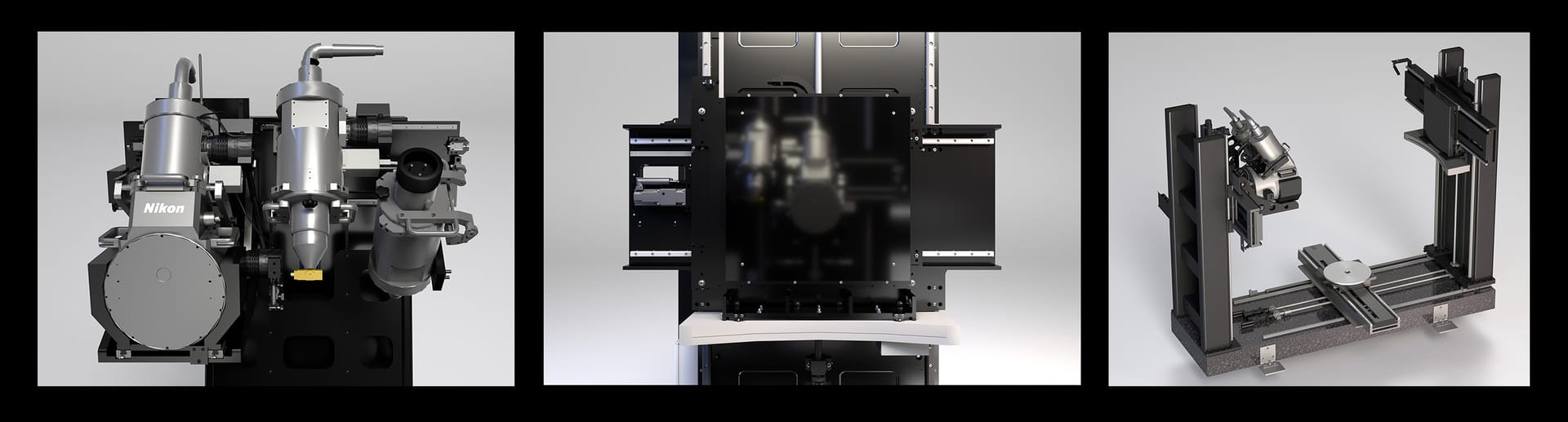
Major CT system components that all play a big role in quality inspections.
Manufacturers that produce critical parts and equipment rely on nondestructive testing (NDT) inspectors to ensure components meet safety and quality standards. Today, new technology, evolving standards, and a shortage of qualified technicians are forcing training organizations, equipment providers and manufacturers to rethink how they prepare the next generation of inspectors.
Expanding Access with Simulation and Virtual Tools
Manufacturers, inspection labs, and NDT training schools are adding simulation software and virtual training platforms to give students access to realistic practice without relying solely on physical equipment. Kyle Stoll, NDT program manager at Nikon Metrology, said simulation software has become an important tool for teaching both fundamentals and advanced techniques.
“We have explored the use of digital twin software for simulation of both 2D X-ray and 3-D computed tomography (CT),” he said. The technology allows instructors to design lessons around simulated defects that may not be available in physical parts, and students can practice techniques without waiting for access to expensive CT machines. Stoll added that simulations also help students apply their studies to the real world. “You can show a simulation output based on theory and then go to a physical system to see the theory play out in reality,” he explained.

In Nikon’s Inspection Services group, simulation has even been used to test defect detectability in parts that lacked a representative quality indicator. While not a substitute for real-world testing, Stoll said simulations “provide more confidence in defect detection than simply using nothing when an RQI does not exist.”
Scott Bucholz, COO of Magna Chek, also sees value in simulation. He said augmented reality and AI-driven tools give inspectors hands-on experience in a lab setting before entering the field. “We combine these simulations with hands-on workshops and training sessions for both new and experienced inspectors,” Bucholz said. He emphasized that technology should complement, not replace, traditional expertise.
“We show inspectors how these tools enhance accuracy, reduce repetitive work, and support their expertise,” he said. “It is their skill and judgment as inspectors that ultimately drives success.”
Dana Begun, X-ray and CT specialist at Zeiss Industrial Quality Solutions, said virtual training can also expand access for students who cannot travel. “Remote training, enhanced by simulations and digital learning tools, can often be a more efficient solution and just as effective,” he said.
Some training providers remain cautious about simulation-based instruction because they see challenges in providing equal access for all students. Donald R. Booth, COO of the American Institute of Nondestructive Testing (AINDT), said his organization has not adopted virtual training widely because no tool can yet match the value of live equipment work. “We are definitely keeping an eye on the evolution of these tools, but we haven’t seen anything that warrants replacing traditional hands-on training methods utilizing real equipment,” Booth said. He also pointed to fairness concerns: not every student owns or can afford virtual reality headgear, so schools would need to supply and ship it, raising costs and the risk of damage. These barriers, Booth said, make it difficult to implement virtual training at scale, even as AINDT continues to monitor its development.
David Sanders, consultant and lead instructor, Test NDT, said simulation is most valuable for reinforcing skills after a foundation has been built. “For methods requiring nuanced technique and real-time judgment, the initial on-the-job training should be performed in person,” he said. Sanders uses simulation to expose trainees to rare or hazardous scenarios in a controlled setting but believes hands-on training remains irreplaceable for developing fully competent inspectors.

(A) Lower resolution resulting in missing indications (70µm), (B) Higher resolution that allows detectability of smaller features (20µm)
Adapting to Updated Standards
Certification standards influence how training organizations build their programs. Booth said AINDT updates its curriculum continually to meet changing industry requirements. “Our curriculum is under continual internal audit to make sure what we deliver provides the student a proper educational foundation the industry requires,” he said.
Sanders said updates offer an opportunity to strengthen programs. “While the underlying theory and purpose of each method remain constant, I use changes in standards to revisit our training materials, reinforce best practices, and ensure our team is ahead of compliance requirements,” he said.
Bucholz said Magna Chek took a similar approach, reshaping training to be “more rigorous, goal-focused, and consistent.” He added that prioritizing adaptable candidates and investing in internal employee development have helped ease transitions to updated standards.
Introducing New Tools Without Losing Expertise
The pace of technology change in NDT creates challenges for training. Stoll described how CT scanning has evolved: “Traditional CT has involved having a part placed between the beam and detector and performing a simple circular CT. Over the years, scanning modes like helical motion have allowed technicians to scan something taller than the detector itself. Now there are many scanning modes—panel shift, offset, limited angle, pixel splitting, and tilted CT—that each have a unique application.” He said this evolution requires technicians to stay familiar with a growing toolkit.
AI-based reconstruction is another new area. Nikon has introduced internal training sessions to make advanced tools less intimidating. Technicians and engineers present lessons on topics they’ve mastered, including AI reconstruction. “This has given an opportunity for those who have used the tool to give valuable insight to the team without each person having to learn the lessons from scratch,” Stoll said.
Booth said AINDT has focused on helping technicians transition from film to digital radiography. “Film and digital radiography are two different modalities supported by the same foundation. We help experienced technicians adapt to a digital radiographic world,” he said.
Begun said remote networking and theoretical modeling software are extending training opportunities. Trainees can log in from across the country to practice skills on real systems. Sanders added that blended learning, which pairs digital resources with hands-on instruction, helps experienced technicians adopt digital workflows without losing their confidence in traditional methods.
Recruiting and Retaining a Younger Workforce
The shortage of qualified inspectors has led many organizations to invest in outreach and create more appealing training programs for younger people. Sanders said one barrier is that many young people have never heard of NDT. He has made community outreach a central part of his strategy, speaking at schools, job fairs, churches, and youth programs to explain what NDT is and how to enter the field. He also works with military NDT technicians to help them transition to civilian roles. “The truth is, military NDT is often quite different from civilian applications, and many veterans aren’t fully prepared for that transition until it’s explained to them,” he said.
To retain young technicians, Sanders stresses oversight and culture. He encourages organizations to monitor the quality of daily and weekly training, ensure trainers provide constructive feedback, and create an environment where questions are welcomed. “Today’s generation will not tolerate the negative training environments that many older technicians endured,” he said.
AINDT has invested heavily in an interactive online platform to meet younger students’ expectations for digital learning, Booth said. Nikon offers mentorship opportunities to help young technicians grow into leadership roles and encourages technicians to step into unfamiliar situations to build experience, Stoll said. “The training is a continuous process where experiences are being shared with colleagues at all levels,” he said.
Bucholz said involving younger inspectors in shaping training programs is key. “Keeping ideas fresh and collaborating with young inspectors helps integrate them more into the creation of training and new techniques of inspection,” he said.
Building Talent from Within
Recruiting qualified personnel has been difficult, especially for CT, where expertise is rare. Stoll said Nikon looks beyond technical skills and evaluates cultural fit, then invests in internal training. “This process may take more time upfront with training and getting someone up to speed, but it makes for a much healthier organization down the road,” he said.
Booth emphasized AINDT’s role in expanding the overall talent pool. “We are continually educating as many people as we can as to the opportunities of a rewarding career in nondestructive testing,” he said.
Sanders’s outreach work focuses on expanding awareness of NDT careers in underserved areas and explaining that technicians can enter the field without significant student debt. He said face-to-face engagement has been the most effective strategy to attract new talent.
Training Gaps and Quality Risks
Gaps in training can lead directly to quality problems. Stoll shared an example where an operator used a screen capture function instead of a higher-quality image export. The decision cut resolution in half, which could have caused inspectors to miss flaws. “It came down to a lapse in training,” he said. “In this situation, the reduction in resolution could have resulted in less flaw detection and possibly passing something that would have normally failed inspection.”
Sanders recalled auditing a penetrant testing program at a company with no Level 3 oversight. A technician hired from aerospace had worked independently for years without formal training or procedural control. Sanders’s audit uncovered significant nonconformances, leading to an immediate shutdown of the company’s NDT operations. He then rebuilt the program, wrote procedures, and retrained the technician. “Even experienced technicians require structured onboarding, clear procedural guidance, and periodic requalification,” he said.
Booth said inconsistent on-the-job training requirements across the industry contribute to quality issues. “The lack of industry standardization pertaining to OJT has a direct impact on the quality and consistency of NDT inspections,” he said.
Organizations are working to integrate digital tools and AI without eroding the hands-on expertise inspectors develop in the field. Simulation and virtual training prepare inspectors for complex scenarios, but experts emphasize that no software can replace a technician’s judgment. Solid training requires both new techniques and mentorship from experienced inspectors.