Standards 101
Roderick A. Munro
Standards 101 | Roderick A. Munro
With the ISO 14001 being scheduled for the next release, even the registrars are beginning to instruct auditors on what to start to look for immediately.
Updates are Coming to
ISO 9001, 14001 and 45001

You may see more and more information directed toward the upcoming updates to ISO 9001, ISO 14001 and ISO 45001. The past process used by ISO was to keep the Technical Committees (TC) draft documents mostly secret until the Final Draft International Standard (FDIS) released. That has usually released six months prior to formal release. This round, however, we are seeing more and more information leaking out through a number of sources. Here is a summary of some of the things that we think we know about the new Management System Standards at this stage in their development process.
Proposed release dates:
- ISO 14001 either an amendment 2 to 2025 or a new 2026 – January 2026
- ISO 9001:2026 – September 2026
- ISO 45001:2027 – TBD
With the ISO 14001 being scheduled for the next release, even the registrars are beginning to give instructions to the auditors on what to start to look for immediately. I find this unusual as in the past, the Internal Audit Federation (IAF at iaf.nu) has always given us three years to transition to the new standard. But remember, the releases in February 2024 for Climate Change gave no grace period. So, what might happen this round is a question, and at least some registrars are considering greater caution about how quickly ISO 14001 registered companies may have to be ready for the new standard. If the new standard comes out as ISO14001:2015 amendment 2, then the worst-case scenario is that I as a registrar auditor may be required to start writing minor findings starting February 2026 for the upcoming changes. Best case is that we get up to three years to conduct a formal transition between the 2015 and 2026 versions of the standard. So, the caution to all registered companies is to start planning very soon to be ready for however the IAF and ISO dictates the release of standards for this round!
What is expected for the upcoming new ISO 14001 is an expansion of risk-based thinking and probably more around climate change. That is a distinct possibility of what is ahead. The table below is from several sources, that I am aware of, on specific areas to be addressed in the new standard. These are still preliminary and hopefully the FDIS will be released soon so that we can see what the changes will be for sure.
Following are other areas to consider.
Life Cycle Perspective is defined in the current ISO 14001:2015 as representing the time from which a company buys the raw materials until they sell the final product. This is different from a full Live Cycle Assessment (see ISO TS 14072, ISO TS 14074, ISO TR 14047 and others) which requires controls of environmental issues from cradle to grave (from the time something comes out of the ground to the final disposal). The new ISO 14001:2026 appears to be pushing the Perspective definition to now include at least considerations of environmental issues from your suppliers through how your customer might use your products, which could impact the environment. You may not be able to control your customers, but you should be able to dictate some potential requirements to your suppliers/vendors. Many companies have already started doing this; however, if you have not documented this broader view at this time, it may be a good idea to start looking at this now. In either case, more documented information on how you are looking at supplier environmental aspects and impacts may be required.
Leadership will now be required to demonstrate their active roles in several areas of culture including ethics, accountability and sustainability. Culture seems to be an underlying theme, and may be the most impactful, of what is coming. For more information on this, see ISO 10010:2022 Quality management — Guidance to understand, evaluate and improve organizational quality culture (figure 2 is from the ISO 10010).
Pull Quote
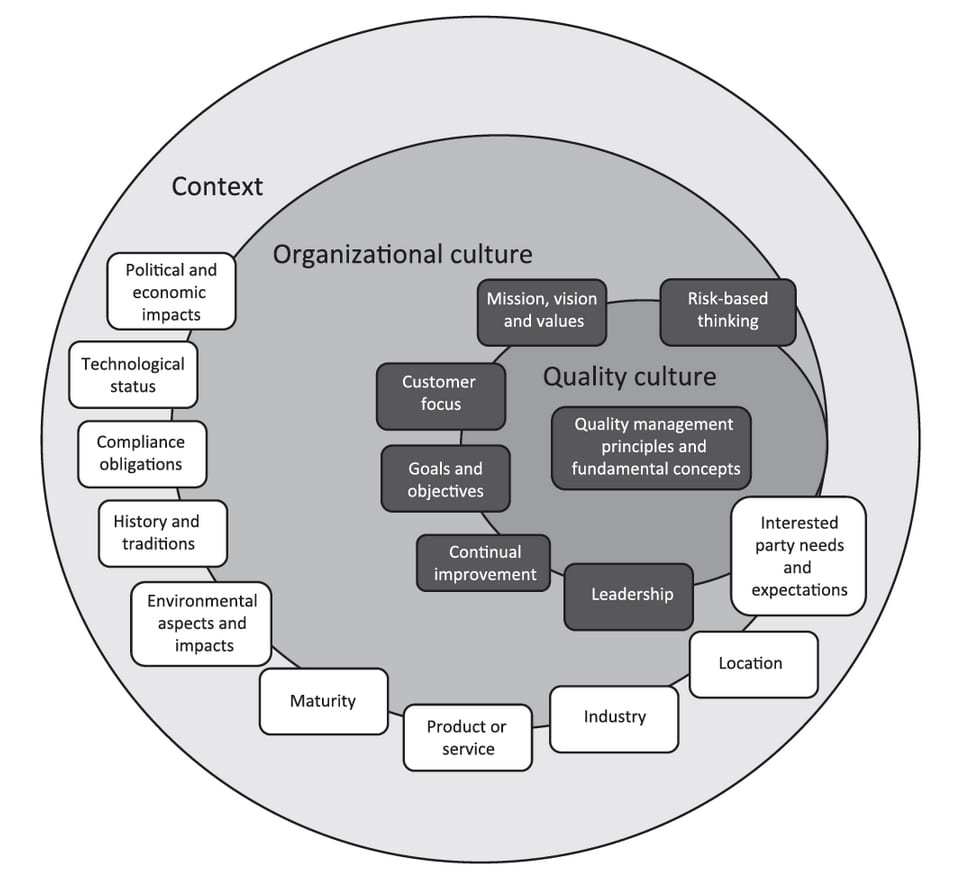
Figure 2. Example of a relationship between quality culture and organizational culture.
The word culture may be missing directly in the new standards; however, it is becoming clear in the ongoing online discussions that registrar auditors will be adding this to audits very soon. For the ISO 14001, top management will need to be ready to demonstrate (and maybe even document) how they are actively involved in the environmental aspects and impacts for ethics impacts meeting government processes, accountability of the environment and for ongoing sustainability of the organization to meet any and all environment regulatory issues or customer requirements. This will need to be demonstrated for both 5.1 leadership and 9.3 management review.
Risk-based thinking may be one area that nearly all organizations will need to update in their documented information in order to ensure that these new views of aspects and impacts are being considered and how, if needed, they are being controlled. Many organizations have already started discussing sustainability in their EMS process and that will probably now be needed to be better documented for the new standard.
The conversation around the ISO 9001:2026 has been about the inclusion of “culture”. This idea is now taking shape with the concepts of ethics, accountability and sustainability being added as part of the organization culture initiatives. And new areas are starting to be discussed for organizations to be thinking about and potentially needing more documentation in their QMS. These include looking at sustainability and ethics for interested parties, leadership needing to demonstrate their roles in these new aspects of quality, and consideration for emerging technologies and verification requirements in the use of software systems or artificial intelligence (AI).
For organizations that are registered only to the ISO 9001, it may be very advantageous to pay close attention to what finally comes out in the ISO 14001. The standards are being more commonized to allow integration. Additions in ISO 14001 could also very well appear in the next ISO 9001:2026.
The Technical Committees (TC) are only now developing their first committee drafts and are in discussions with the worldwide network to start the development process. But as stated, given the movement to commonize the management system standards (MSS) to a greater extent to ensure easier integration for those companies who chose that approach, any organization registered to ISO 45001 would be well advised to pay close attention to the releases of the ISO 14001 and ISO 9001 as they are released.
One example of accountability was just recently shared with me by a general manager at a plant. They had a repair being done to a floor and numerous barriers, caution tape and signs posted to say away from the danger zone. However, one employee chose to go around and under the barriers and fell two stories hurting himself very badly to the point that he would never walk again. The employee’s family stood at the hospital bed blaming the general manager for doing a very bad job in protecting their loved one! In this situation the general manager said that there was nothing he could do to defend the company with the grieving family.
The topics of culture, ethics, accountability and sustainability seem to be a thread and will probably find their way into the ISO 45001. Other topics that are being suggested include:
- Mental Health and Psychosocial Risks:
The revised standard could explicitly address mental health and well-being as part of the OH&S management system. - Hybrid and Digital Work Models:
The standard could incorporate the impact of remote work, digitalization, and new workplace realities on employee safety and well-being. - Resilience and Business Continuity:
The revision will likely strengthen emergency preparedness and response to better equip organizations to handle disruptions. Business Continuity can be further reviewed by referencing ISO 22301. - ESG Integration:
Occupational health and safety could be aligned closer with environmental, social, and governance (ESG) principles, emphasizing ethical conduct and sustainability. - Focus on Opportunities:
The revision could shift the focus from solely preventing harm to identifying and capitalizing on opportunities to improve health and well-being. So, the need to record more near missed or other preventive measures could be required in the documented process. - Alignment with Annex SL:
The new version is to align with the updated ISO High Level Structure (HLS), potentially streamlining the standard and clarifying areas that have caused confusion.
All in all, these proposed changes are not being viewed as major changes to any of the three new management system standards. They will all be considered upgrades and hopefully we will have the three-year transition for each standard. Organizations are encouraged to start looking at your current management systems to view them in the light of these potential changes and apply some continual improvements methods to get a head start on what is likely coming. You are encouraged to contact your registrar to see if they have any ongoing updates that you can access to help you in your journey.
Implications to your organization’s internal audit process: If the ISO 14001 does come out as an amendment instead of a full revision, the IAF may choose to make the changes immediate instead of the normal three-year transition. That means that your registrar auditors will be writing findings on all of the new stuff if you have not updated your EMS. This includes updating your internal auditor training and auditing to the new requirements. Thus, paying close attention to the upcoming ISO 14001, especially when the FDIS is released, means you may need to start training your internal auditors quickly to the new requirements.