Aerospace Column
Francois Gau
Aerospace Column | Francois Gau
Ideally, the 3D CAD model is a single source of truth, containing both geometry and product manufacturing information.
The Gap Between OEMs’ 3D MBD and Supply Chains

For decades, OEMs and supply chains have lived in different, deeply connected, and highly dependent worlds. Design engineers focus on creating parts that meet form, fit, and function requirements. These parts ultimately find their way into products that define modern life, including car engines, airplane landing gear, and MRI machines. Everything today begins in CAD software, where a part is imagined, designed, assembled, and refined in three dimensions.
At the other end of the supply chain is manufacturing. For hundreds of years, machinists and fabricators have perfected the ability to turn drawings into reality. Traditionally, they relied on 2D representations such as blueprints that expressed every dimension and tolerance, to create physical parts.
Over the last 50+ years, CAM software has accelerated this process by taking CAD models, translating them into machining instructions, producing the G-code that drives today’s CNC machines, and generating 2D prints, where drafters completed what the designer created with limited/critical dimensions.
In theory, this end-to-end digital process with 2D prints should be seamless. However, it has become more complex in the last few years, when OEMs decided to collaborate with their supply chain partners using 3D MBD (Model Based Definition).
The Missing Link: PMI and 3D Models
Modern manufacturing demands more than just shapes and surfaces. Before any part ships, manufacturers must prove, through inspection and quality reporting, that the part meets design requirements. In the old days, that meant calipers, micrometers, and gages. Today, coordinate/vision measuring machines (CMM/VMM) dominate inspection, and they require digital inputs on what to measure, how to measure it, and more.
The bridge among design, manufacturing, and quality is MBD with PMI (Product Manufacturing Information), which is the digital packaging of everything beyond geometry, including:
- Surface Finish Specifications
- Material Properties
- Bill of Materials (BOM)
- Critical Notes and Instructions
Ideally, the 3D CAD model is a single source of truth, containing both geometry and PMI. With that assumption, OEMs want to focus on 3D only. In practice, that ideal falls short.

Caption
Source: High QA
The standard provides a systematic approach to sampling without overtaxing resources.
This isn't the future.
It's today's best practice.
Too Many Systems, Some Standards
The global CAD/CAM/CMM/VMM Gages ecosystem is fragmented. Consider this:
- The top 10 major CAD platforms
- The top 10 CAM solutions to convert models into machining tool paths
- The top 10 CMM/VMM software packages to measure and analyze features on parts
- And, thousands, non-digitized, manual quality gages (i.e., paper/pencil, XLS)
Multiply them, and you’re staring at tens of thousands of possible combinations. No manufacturer and quality management professional can realistically be fluent in all of them. Because there is no universal standard for passing data from CAD to CAM to CMM, translation and manual data entry are the rule, not the exception.
Most times translations work smoothly. Sometimes, data is dropped, distorted, or misinterpreted. A spec callout might not survive an export. For example, a surface finish spec might vanish. Or worse, a machinist may misinterpret an incomplete model and machine to the wrong tolerance.
At that point, human intervention is required, and someone must double-check and re-enter missing details by taking screenshots on one and manually update the other. This dynamic reintroduces the risk of error that digital systems were meant to eliminate.
Why We Can’t Wait Any Longer
The manufacturing sector has been talking for decades about digital interoperability standards. But talk hasn’t kept pace with production demands. Meanwhile, OEMs in aerospace and defense are driving their supply chains toward “paperless” programs or digital-first processes that expect the 3D model to serve as the single source of truth, from design through inspection.
For suppliers, this shift creates enormous pressure. If you cannot reliably work directly from the OEM’s 3D model, you risk being excluded from future contracts. The cost of investing in training, translation tools, and rework gets higher each year.
This isn’t a theoretical problem. It’s a present-day bottleneck that impacts lead times, part quality, and supplier competitiveness.
Emerging Solutions, Different Thinking
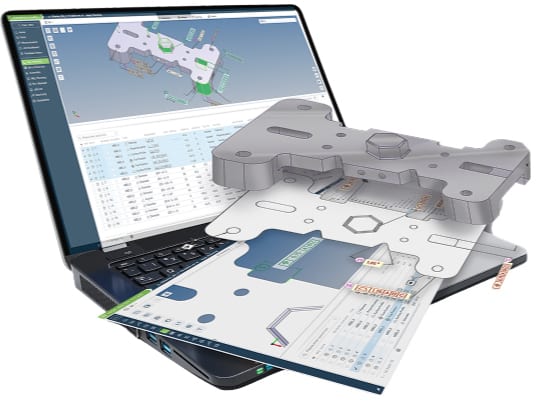
Fortunately, some innovators are addressing this issue head-on. One example is a 3D-MBD Integration approach. This system has been automatically extracting GD&T from a 2D drawing to a Bill of Characteristics (BOC) for years. Now, it can extract PMI from any 3D CAD models into a BOC. PMI remains the “One Source of Truth.” This system automatically creates inspection plans, assists in data collection, and automates FAI/PPAP documents creation.
These documents can then be shared across engineering, manufacturing, and quality teams internally and with supply chain partners, closing the gap between MBD design and parts delivery. This approach eliminates the fragmentation problem. Instead of asking all parties, including employees, to chase data across multiple systems, the software does the heavy lifting.
Similar solutions are emerging from other providers, with the common thread being automation of PMI extraction and translation.
The Way Forward
So, what’s the challenge with 3D models for manufacturing? It’s not the models themselves. CAD tools are incredibly powerful, and PMI has matured into a reliable way to capture design intent. The problem lies in the gaps between how designers describe the part and parts delivery, using a particular description to confirm the part was made correctly.
As the data moves from one software package to another, some of it is “lost in translation” and must be interpreted by talented staff.
Until we close those gaps with robust standards and interoperable tools, manufacturers will keep spending time, money, and energy on translations and manual verification. The good news is that momentum is building, and OEMs are demanding solutions. Software providers are innovating, and suppliers are increasingly aware that digital integration is essential rather than optional.
The road ahead won’t be easy, but it’s clear: Paperless, model-based manufacturing is coming. Those who embrace it will stay competitive. Those who resist risk being left behind.