H2 Deck By Bold Name
h2 xxxxxx
H1 xxxxxx
h2 xxxxx

Management
Automation doesn’t improve a broken process; it runs it faster. By Genevieve Diesing
Getting Automation Right from the Start
Automation
H2 Deck Info By Paragraph Style Bold
Headline
Many manufacturers want to automate but struggle to figure out where to begin. The hesitation is understandable, and according to people who work with manufacturers on these projects, it’s also one of the biggest obstacles to getting started.
The better approach, they say, is to start narrow, focus on processes that are clearly costing money and treat early projects as iterative rather than definitive. Getting that foundation right matters, because what comes after depends on it.
Start where the money is
The most reliable place to begin is wherever the financial pain is greatest. For most manufacturers, that means looking at where waste, scrap and manual inspection are consuming the most resources. Those costs are visible, measurable and directly tied to the bottom line — which also makes them the easiest to use when building a business case for investment.
That focus matters more than the specific technology chosen. Many manufacturers assume they need a custom solution when general-purpose tools already on the market can handle the job. Before designing anything from scratch, it’s worth asking whether existing systems can already detect or measure what the process requires. “There are many general-purpose automation and measurement systems on the market today,” said Gretchen Alper, business director for North America at AT Sensors. Starting with what’s available, she said, can significantly reduce cost, integration complexity and time to deployment.
For teams that have never automated, the most accessible entry point is often data. Jay Arthur, founder of KnowWare International, recommends starting by automating statistical process control — running control charts and capability analysis rather than tracking performance manually. Control charts catch unstable conditions before they compound; capability analysis tells teams whether the process is meeting customer requirements. But the order matters. “You have to be stable before you can analyze capability,” Arthur said. Until that stability is established, capability data won’t mean much, and defects will keep occurring regardless of how efficiently the process runs.

The process has to be ready
One of the most common and costly mistakes manufacturers make, according to Alper, is automating a process before it’s well-defined. Automation doesn’t improve a broken process; it runs it faster. Every flaw in the original design gets locked in and repeated at scale.
That means the work of defining the process has to happen before any equipment is selected or installed, Alper said. Teams need to know what they’re measuring, why they’re measuring it, what an acceptable result looks like and how variability gets handled. Without those answers, the automated system will produce results that are repeatable but wrong. “Automation doesn’t fix a poorly defined process — it makes it repeatable,” she said.
For manufacturers moving from manual to automated inspection, Sam Serhan, president of TecScan Systems, said this transition is also an opportunity to eliminate workarounds that have built up over time. Manual processes tend to accumulate informal rules, habits and shortcuts, he said, and most of them can be dropped when the process gets redesigned for automation. And because automated systems produce complete records of every inspection, any bad habits that attempt to return are easy to detect and address.
Some things shouldn’t be automated first
Not every automation opportunity is worth pursuing, at least not immediately. The temptation is often to start with the most complex or labor-intensive process — but complexity alone isn’t a good reason to prioritize something. Serhan points out that low-volume or infrequent parts are often poor candidates for a first automation project. “Even though it’s tempting to automate the most complex parts or the ones that are the most labor intensive,” he said, “if these parts are low volume and frequency, you may not get the bang for your buck that you were hoping for.”
The calculus is also different depending on what a team already knows how to do, Alper said. A team with existing vision engineering experience can reasonably start with a vision application using off-the-shelf software. A team that has always inspected manually is probably not ready to jump straight to a robot-based three-dimensional measurement system, even if that system would ultimately be the right solution. The size of the leap matters, she said. There’s a meaningful difference between a process that stretches a team’s capabilities and one that exceeds them entirely.
A useful filter for prioritizing is to look at where defects, waste and rework are concentrated. Arthur puts it plainly: his rule of thumb holds that a small fraction of any operation — roughly 4% — typically accounts for more than half of its waste, rework and lost profit. Starting there, rather than spreading effort across every inspection point, tends to produce faster and more meaningful results.
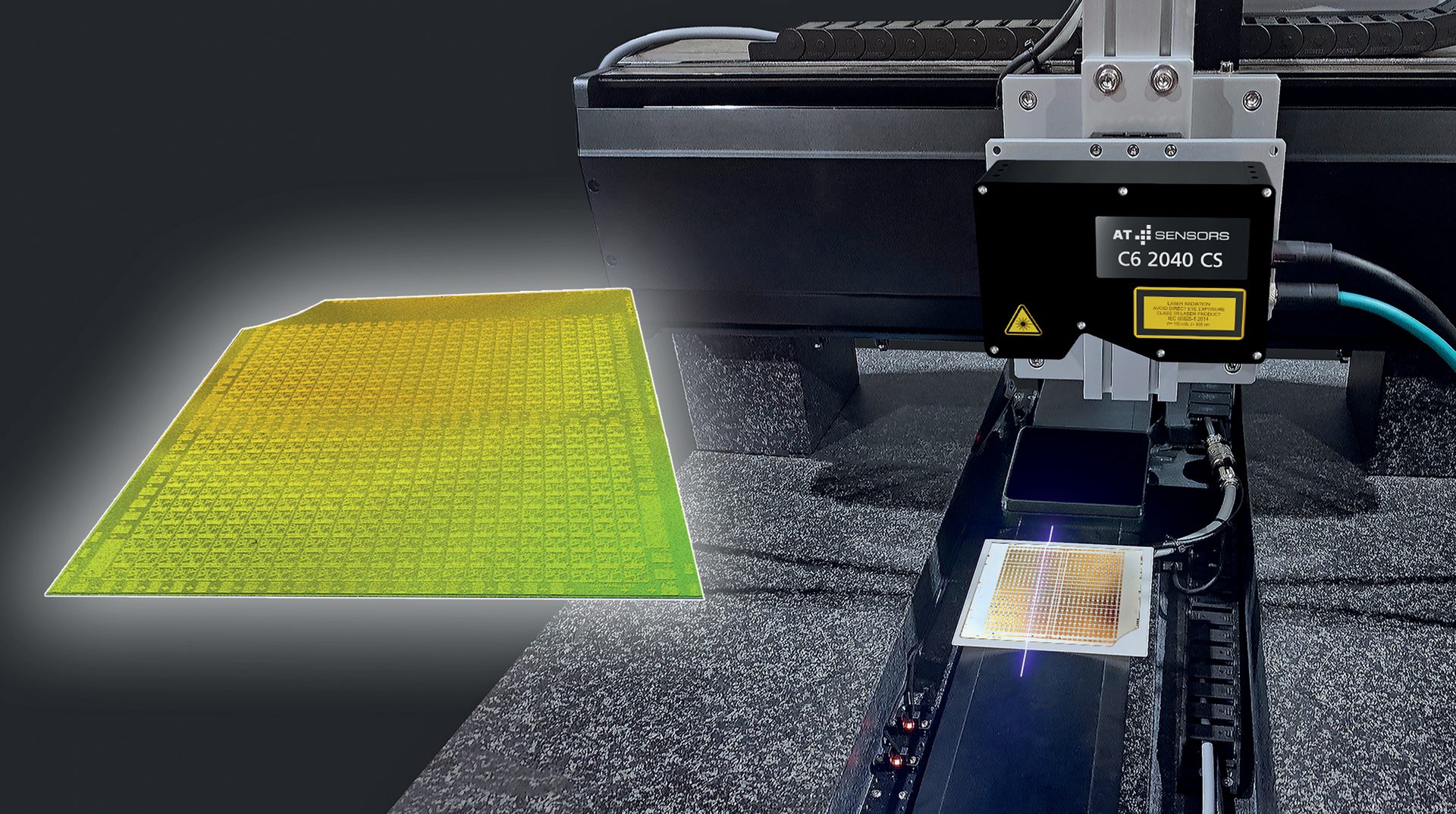
Semiconductor device inline planarity check with AT-Sensors 3D laser profilers
Making the case when budgets are tight
Automation projects often have to compete for funding against other capital priorities, and quality teams don’t always win that argument. The strongest cases, Alper said, are built not on the cost of the system but on the return it generates.
Most automation investments pay off through some combination of improved yield, reduced scrap, lower inspection labor costs and faster cycle times. The key is identifying which of those factors is most significant in a given operation and calculating how quickly the savings offset the upfront cost. “When you quantify the return, rather than just the cost, the justification becomes clear,” she said.
There are also benefits that are harder to put a number on but still matter to management, Serhan said. Automating repetitive inspection frees skilled workers to do higher-value work and tends to reduce the fatigue-related errors that creep into manual inspection over long shifts. And because automated systems document every result, audit preparation becomes significantly less labor-intensive. Those are real gains, he said, even when they don’t show up directly in a cost-savings calculation.
What improves — and when
The quality metrics that improve first after automation depend on how clearly the problem was understood going in, Alper said. When teams already know the exact defect they’re targeting and design a system around it, throughput tends to improve quickly, because the system can run at production speeds while still catching what matters. When teams are still working out what constitutes a real defect versus acceptable variation, scrap and rework rates are where progress shows up first, as inspection criteria get refined through iteration.
Alper offered a concrete example from the beverage industry. A can inspection system that scans warpage of the can top and automatically adjusts internal pressure within milliseconds can accomplish something traditional ultrasound methods cannot: 100% inspection at full production speed. The system works because it links a specific, well-understood measurement directly to a process control response in real time. The quality benefit is outsized, she said, precisely because the problem was so well defined before any equipment was selected.
Process stability is another early indicator worth watching, Arthur said. When control charts replace manual tracking, teams often discover variation they didn’t know existed — not because the process got worse, but because the data is finally reliable enough to show what was always there. Addressing that variation, even before other metrics move, puts the process on firmer ground for everything that follows.
What nearly always improves immediately is consistency, Serhan said. Every part gets inspected the same way, by the same criteria, regardless of who is on shift or how long they’ve been on their feet. That repeatability is also what makes automated systems defensible to customers and auditors. “One of the most important metrics is consistency,” he said. “Knowing that each inspection is carried out the same way and the results do not vary based on unrelated factors.”
What to expect
Manufacturers who have made the transition from manual to automated inspection tend to report the same thing afterward, Serhan said: they wish they had done it sooner. The concerns that slowed them down — implementation complexity, staff learning curve, reliability — turned out to be more manageable than expected.
That doesn’t mean every first project goes smoothly. Automation development is iterative by nature, Alper said, and early systems rarely stay unchanged. Tolerances get refined, measurement criteria get adjusted, and the process gets tuned as teams learn what the data is actually telling them. Working through that process is where most of the real learning happens, she said, and having a clear original objective is what makes the difference between productive iteration and wheel-spinning.
What Alper and others emphasize is the importance of knowing what you’re trying to accomplish before deciding how to accomplish it. A team that starts with a specific, well-defined measurement goal has a much clearer path forward than one that starts by selecting equipment. “Be very specific about what you need to measure, but not how you think it should be done,” she said. “Define the ‘what’ clearly, and stay flexible on the ‘how.’”
The technology itself is often less of a limiting factor than the clarity of the problem being solved, Alper said. Teams that invest time upfront in defining that problem precisely tend to find that the right solution, and the return on it, follows more reliably.