Products
the latest products to help you improve your manufacturing process
FANUC America Ultra Lightweight CRX-3iA Collaborative Robot
FANUC America has expanded its popular CRX collaborative robot series with the introduction of the CRX-3iA , an ultra lightweight cobot designed for fast redeployment across small, high mix tasks. Weighing only 11 kg (24 lbs.), the CRX 3iA can be carried and set up in minutes, giving manufacturers a portable way to automate jobs such as welding, part handling, small assembly, screwdriving, tool positioning and inspection—especially in tight spaces or temporary work areas where permanent fixtures aren’t feasible.
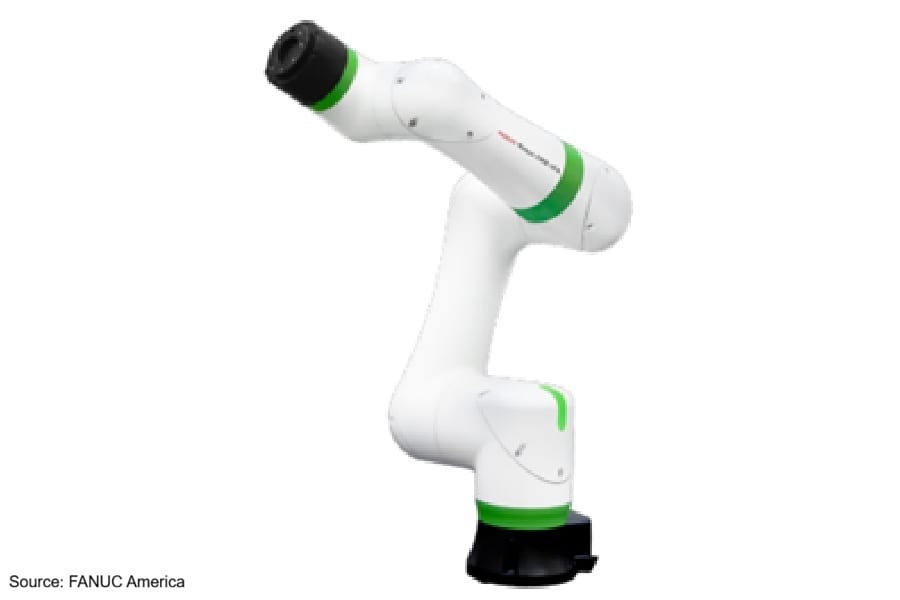
In addition to introducing the newest model in the CRX family, FANUC is rolling out several new capabilities across the full CRX lineup. These enhancements expand the range of applications that collaborative robots can support—from heavier palletizing and high throughput fastening to coordinated welding and advanced motion control—giving manufacturers more flexibility to automate both small, high mix tasks and larger, mass production scale operations.
“The CRX-3iA puts collaborative automation in the hands of operators—literally,” explains Eric Potter, general manager, robot application engineering segment, FANUC America. “Its lightweight design makes it easy to redeploy in minutes, helping manufacturers automate jobs that were once too small, too scattered or too costly to justify. Combined with new capabilities across the CRX lineup, we’re giving our customers more ways to apply collaborative robots safely and productively across their entire operation.”
The CRX-3iA brings a new level of mobility and flexibility to FANUC’s collaborative robot family. With a 3 kg payload, 692 mm reach and lightweight design, the CRX-3iA is engineered for rapid repositioning and tight space operation.
CRX-3iA Key Features
- Ultra lightweight design: Can be carried by a single person and quickly moved to workstations, temporary setups or field environments.
- Flexible installation: Supports magnetic bases and offers effortless wall or ceiling mounting with automatic angle detection and no manual input.
- High mix task support: Ideal for welding, part handling, small assembly, screwdriving, tool positioning and inspection tasks.
- Portable welding capability: Can be manually moved to the welding area for fast repositioning with support for touch sensing, eliminating the need for precise robot placement. Additionally, auto weld point detection and auto path generation easily accelerate welding setup.
These capabilities make the CRX-3iA a practical solution for manufacturers seeking to automate small or variable tasks without committing to permanent fixtures or complex integration.
Several new features and options that expand the performance and versatility of the entire CRX family include:
- New “Triangle Weave” Vertical Up Welding Profile
A breakthrough solution for out of position welding, FANUC’s newly developed triangle weave profile counteracts weld puddle sag and replicates the precision of a skilled welder, enabling successful Vertical Up welding where automation traditionally struggled. What was once a major challenge can now be achieved with confidence through an intuitive, easy to use interface. - Enhanced Palletizing Performance
Palletizing by the CRX-30iA now supports up to 40 kg payloads. When paired with a new high flow air kit designed for large suction grippers, this enhancement enables collaborative palletizing of heavier cases while maintaining safety and ease of use. - High Inertia Mode for Assisted Heavy Moves
A new high inertia mode allows CRX cobots to guide extremely heavy loads while a lift assist device carries the weight. This hybrid approach automates previously manual, ergonomically challenging operations while preserving collaborative safety. - Dual Nut Runner Support
CRX cobots can now operate dual nut runners to double fastener throughput. An optional internal wiring harness supports clean cable routing and maintains collaborative safety standards. - CRX on R-50iA Controller
The CRX lineup will also be available on FANUC’s new R-50iA controller, enabling advanced capabilities including:- Python scripting
- Higher frequency ROS 2 and streaming motion support for AI-driven application
- Advanced Cybersecurity protection
- Positioner support
Support for Auxiliary Axis part positioners now enable coordinated welding and laser applications.
These enhancements broaden the CRX family’s reach into more demanding applications while preserving the simplicity and safety that define collaborative robotics.
FANUC’s CRX-3iA is now available for customer order.
FANUC America Corporation
www.fanucamerica.com
CRX.FANUCAmerica.com
InnovMetric PolyWorks 2026
InnovMetric announced the launch of PolyWorks® 2026. This major release delivers three key pillars of innovation:
- A data management solution in a cloud-based Software as a Service (SaaS) model
- Improved software compatibility to support a broader range of measurement devices
- An AI assistant designed to provide technical support 24/7

PolyWorks 2026 empowers metrology engineers and quality control managers to implement standardized dimensional inspection processes, facilitating multi-site collaboration among metrology teams, as well as with external suppliers.
PolyWorks 2026 introduces two major enhancements that leverage a digital thread framework to create the ultimate inspection lab:
- DataLoop Cloud™, a SaaS solution designed to ensure secure data centralization for manufacturers seeking to outsource their data management server setup and maintenance, thereby simplifying deployment and reducing ongoing upkeep.
- Seamless sharing of PolyWorks|Inspector™ licenses as well as piece measurement templates with tailored interfaces, streamlining multi-site inspection by driving standardization and boosting efficiency.
The universal metrology platform delivers four key extensions, enabling metrologists to work smoothly and with greater flexibility:
- A Computed Tomography (CT) scanning module that automates CT-based multipiece inspection in production environments.
- A web-based data app that allows collecting and consolidating data from handheld gauges and visual checks, directly on the shop floor.
- Real-time integration of portable multi-line scanners within PolyWorks|Inspector, enabling direct processing of scan data and eliminating manual transfers as well as the need to switch between software platforms.
- Advanced 5-axis probe head support that includes native go-to-positioning, head-touch measurement, and built-in collision analysis functionalities.
InnovMetric also launched MyPolyWorks AI, a smart assistant fully integrated into the MyPolyWorks customer portal. Available 24/7, it provides instant, reliable technical answers in the customer’s preferred language and includes hyperlinks for deeper insights.
“We dream with our customers, and together, we’re taking a step closer towards the ultimate inspection lab—a place where data flows digitally, complex tasks become simple, collaboration between humans is effortless, and traceability is achieved without stress,” says Marc Soucy, co-founder and president of InnovMetric. “We chose this path because measurement data drives manufacturing agility. When companies have accurate, traceable data, they can maximize quality, make better decisions and reduce time to market. Our innovations connect people, processes, and data through a digital thread, empowering manufacturers to stay competitive and thrive in a rapidly changing world.”
InnovMetric
Polyworks.com
ABB Robotics High-Speed PoWa Cobot Family
ABB Robotics is combining the flexibility of cobots with higher payloads and performance, with the launch of its new PoWa™ cobot family into the rapidly expanding global collaborative robot market, which ABB Robotics estimates will grow by 20 percent annually through to 2028.
“Cobots are growing significantly faster than traditional industrial robots, driven by demands from both small and midsized companies starting their automation journey as well as large enterprises,” said Andrea Cassoni, Head of Collaborative Robots at ABB Robotics. “These customers are seeking higher speeds and payloads, but also greater ease of use, and compact designs. Established manufacturers want to automate heavier, fast cycle applications, without the complexity and operational rigidity of traditional industrial robots. We are meeting these needs with the global launch of our high-speed PoWa™ cobot family – a name that symbolizes its powerful, industrial-grade performance in a compact collaborative robot form.”
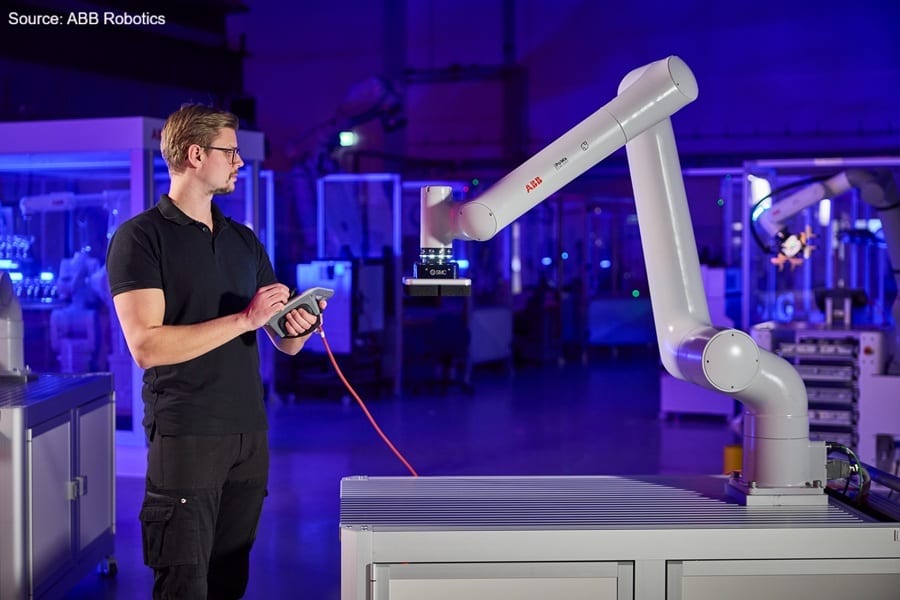
The new PoWa family addresses a long‑standing gap in the market between traditional cobots, that often lack the speed and payload required for industrial applications, and conventional industrial robots, which are designed for highly specialized, large-scale automation environments, going beyond the needs of many collaborative tasks.
PoWa extends ABB Robotics’ comprehensive cobot offer with industrial-grade performance including six different payload categories, from 7kg to 30kg, the longest reach and highest arm load on the market and best-in-class top speed of up to 5.8 m/s.*
Purpose-built for compact environments and ideally suited for applications such as high-speed machine tending, palletizing, screwdriving and arcwelding, PoWa enables manufacturers to automate heavier and faster processes, while maintaining the flexibility, ease of use and compact footprint of collaborative robotics.
PoWa cobots are exceptionally easy to use, through programmable buttons on the arm-side interface and no-code programming and are compatible with an extensive ecosystem of third-party accessories. PoWa can be unboxed and operational within an hour and enables seamless plug-and-play with a wide range of tools, blending industrial-grade connectivity and performance with collaborative robot flexibility.
Powered by the ABB OmniCore™ controller platform, the new PoWa cobots deliver best-in-class motion control, speed, and precision and can be integrated with ABB Robotics’ expanding suite of AI-powered software, including Robot Studio® and Wizard Easy Programming, enabling intuitive programming, fast deployment and maximum uptime.
Ensuring collaborative robots can do more things, in more places, and do it faster, safer and smarter is part of ABB Robotics vision for more autonomous and versatile robotics (AVRTM). By developing a new generation of intelligent, flexible, adaptative, and collaborative multi-skilled robots, ABB Robotics furthers robots’ ability to learn, understand and plan independently, giving them greater autonomy and versatility.
ABB Robotics
go.abb/robotics
Bosch Rexroth Next-Generation Conveyor
Building on its established portfolio of twin-strand conveyors that are currently used in a variety of industry verticals, Bosch Rexroth is introducing the TS 7plus transfer system, it’s first freely configurable, fully electric conveyance solution to workpieces weighing up to 3,000 kg.
TS 7plus transports material via conveyor rollers on freely configurable modular sections with lift/transverse, rotary, and positioning units, as well as stop gates. The 350mm minimum possible transportation height for both longitudinal and transverse conveying helps facilitate manual processes and improve ergonomics for employees, while the standard dimensions of the workpiece pallets are up to 2,200 x 3,000 mm.
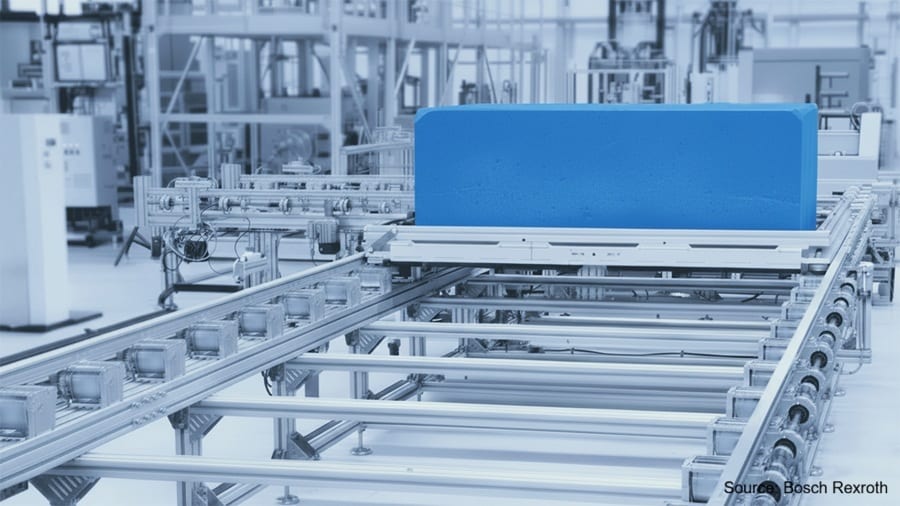
The conveyor section consists of either solid or hollow rollers, which are approximately 50 percent larger than the previous TS 7 system. The reduced number of moving parts per meter increases availability and the newly designed bearing block enables faster assembly with two mounting tabs in the profile, as well as easy replacement for maintenance.
Unlike chain drives, the tried-and-tested drive via king shafts operates without lubrication and requires minimal maintenance. The motor’s torque is transmitted to the conveyor rollers via bevel gears, thus minimizing contamination of the workpieces. The bevel gears also require no re-tensioning or maintenance.
In conventional accumulation operations, stop gates keep workpiece pallets at defined stations. With the alternative segmented operation, the motors for section transport, rotary units, and lift/transverse units run only when required. This increases energy efficiency across the entire life cycle and significantly reduces the total cost of ownership. In addition, the motors can be designed smaller and benefit from a longer service life due to their demand-based operation. Bosch Rexroth offers motors with outputs of 180 W and 250 W for the TS 7plus, as well as an interface for the use of third-party motors.
The motors can be placed on either the outside or inside of the section. With internally mounted motors, there are no interfering contours that could otherwise hinder employees or protrude into travel paths. With a conveyor speed of up to 24 m/min, the system achieves significantly shorter transport times than automated guided vehicles (AGVs).
The intuitive planning software MTpro assists in the configuration of transfer systems, including TS 7plus, and guides users quickly and easily through the process. Bosch Rexroth offers the software as a locally installable full version and as an installation-free web version in the form of MTpro Online Designer. The software automatically creates CAD models and parts lists from builds, which can be transferred to the Rexroth Store or to certified partners.
Bosch Rexroth
www.boschrexroth-us.com/ts7plus
Basler CoaXPress-over-Fiber TDI Vision System
Basler AG announced a CoaXPress-over-Fiber TDI vision system with a bandwidth of up to dual 100 Gbps. It impresses with seamless integration of compatible components, such as a TDI line scan camera, programmable data forwarding frame grabber, software, transceiver modules, cables, and cooling solutions. Basler's experts support customers with the integration of suitable components, such as lenses and lighting, and development and consulting services.
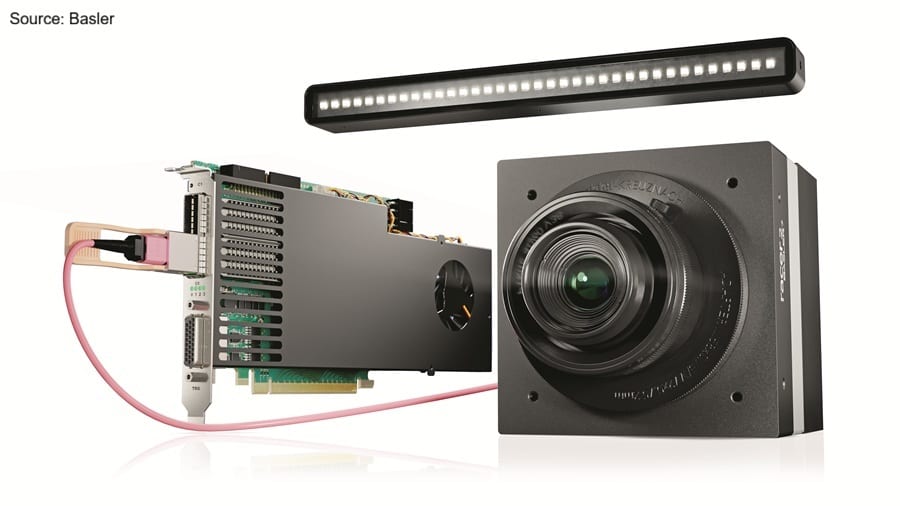
A special feature is the high data reduction through image preprocessing on the frame grabber using the VisualApplets software. This makes it possible to save 20%-50% of the hardware components, such as GPUs, CPUs, and frame grabbers, while also shortening development time and delivering a robust system architecture with a low CPU load. The overall system can be flexibly adapted to different customer requirements and is particularly suitable for wafer and semiconductor inspection, battery cell, flat panel display, and PCB inspection.
The racer 2 XL TDI line scan camera with the latest GPixel GLT5016BSI CMOS line sensor delivers a very high line rate of up to 500 kHz at 16k resolution with 256 TDI stages. Passive cooling fins or an active compressed air cooler are available for cooling the camera. The optical connection ensures electromagnetic compatibility and an almost unlimited cable length. To connect the camera to a frame grabber, QSFP28 data cables are available in various lengths together with a QSFP28 transceiver module.
The camera is compatible with the programmable imaFlex 2 Dual 100 frame grabber. This has two QSFP28 connections to operate up to two racer 2 XL TDI line scan cameras or to connect a camera and an optical data forwarding connection for an additional imaFlex 2 frame grabber with a full bandwidth of 100 Gbps per connector.
"We use our experience to develop and implement TDI vision systems together with our customers in a short space of time. The compatibility of all components and image preprocessing result in a powerful, homogeneous, robust, and future-proof complete system, which significantly reduces the total cost of ownership (TCO) for our customers," emphasizes Jochen Dreeßen, Head of Performance Product Systems at Basler.
Basler AG
www.baslerweb.com/tdi
FARO CREAFORM Cuts Laser Line Probe Time to Data on Challenging Surfaces
FARO CREAFORM, a business of AMETEK, Inc., announced an update for its Laser Line Probe (LLP) portfolio used with the Quantum X FaroArm® Series and Quantum Max FaroArm Series. The update introduces refined image‑processing algorithms designed to improve scan consistency and reduce time to data, particularly when working with parts that feature difficult and contrasting surface finishes.
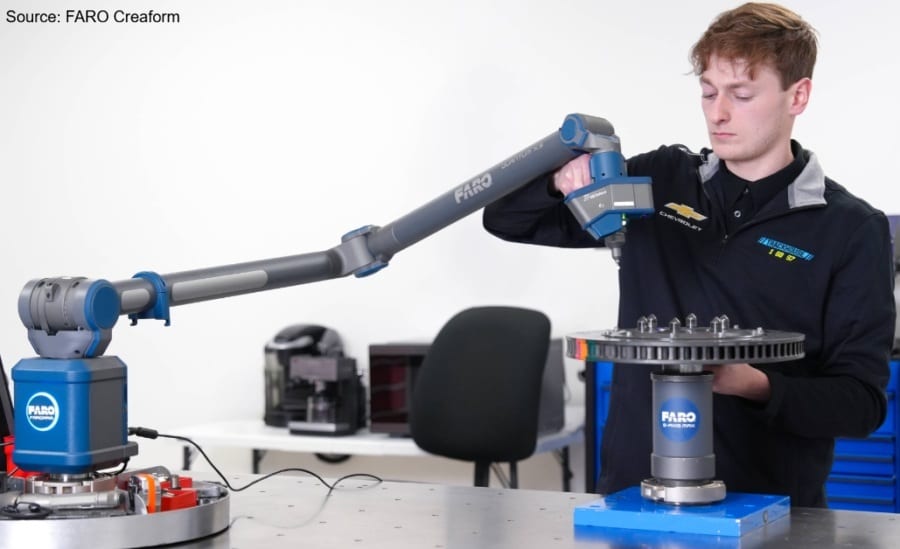
Widely used in manufacturing for non‑contact inspection, reverse engineering, and CAD comparison, Laser Line Probes are often used on dark, shiny, reflective, or highly contrasting surfaces that may require additional setup, multiple passes, or manual adjustment to achieve usable results. This update addresses those challenges directly by improving how LLP image data is processed, helping users obtain cleaner, more consistent point clouds with less effort.
Powered by DTEX, FARO CREAFORM’s approved LLP processing pipeline, the update focuses on providing higher quality results for challenging materials while also reducing the need to fine-tune acquisition parameters. Internal performance benchmarks associated with the release indicate improvements of up to 60% in time to data on representative challenging parts, without compromising measurement integrity.
In addition to LLP improvements, the update also brings renewed attention to the FARO 8‑Axis Max, a metrology‑grade rotary worktable designed to extend the effective reach of FaroArm‑based measurement systems. When used together with the Quantum X FaroArm and LLPs powered by DTEX, the 8‑Axis Max acts as a force multiplier for scanning larger or more complex parts. By measuring part rotation through integrated encoders and combining with synchronized data from the arm, it allows DTEX-enhanced data to be used across the entire part in a single smooth coordinate measurement workflow.
The update applies across the Laser Line Probe portfolio, extending the practical value of these systems in everyday measurement scenarios.
- FAROBlu® xR: Offering the highest-resolution scans, providing quality results for the most critical small features.
- FAROBlu® xS: Offering the most efficient scan times, enhancing throughput in demanding manufacturing applications.
- FAROBlu® xP: The perfect balance of resolution and efficiency, maintaining throughput while providing dense and accurate data
- Quantum X FaroArm® Series: Improved LLP scan accuracy and confidence across a wider range of part finishes, supporting inspection, reverse engineering, and quality control workflows. Compatibility with the entire FAROBlu LLP lineup ensures that these improvements extend across all laser line probe workflow applications.
- FARO 8‑Axis Max rotary worktable: When combined with a Quantum X arm and FAROBlu LLP, provides a more efficient workflow by reducing device moves and improving ergonomics, all while providing high accuracy results traceable to an ISO 17025 accredited calibration process.
This new release focuses on providing more value to existing FaroArm and LLPs, enhancing their workflows without requiring new hardware. By refining the image‑processing layer and simplifying how challenging surfaces are handled, FARO CREAFORM aims to improve day‑to‑day efficiency for both existing and new users, while preserving established measurement practices.
The update reflects FARO CREAFORM’s continued investment in application‑driven improvements across its portable metrology portfolio, supporting manufacturers who rely on consistent, traceable measurement data in production and quality control environments.
FARO CREAFORM
faro.com
creaform3d.com
Peak Technologies Peak Automation Intelligence
Peak Technologies, a global provider of smart technologies, automated supply chain and mobile workforce solutions, announced the launch of Peak Automation Intelligence, an integrated AI-powered platform designed to help manufacturers and operators of warehouses and distribution centers modernize their operations with real-time visibility, automated data capture and high-speed material flow intelligence.
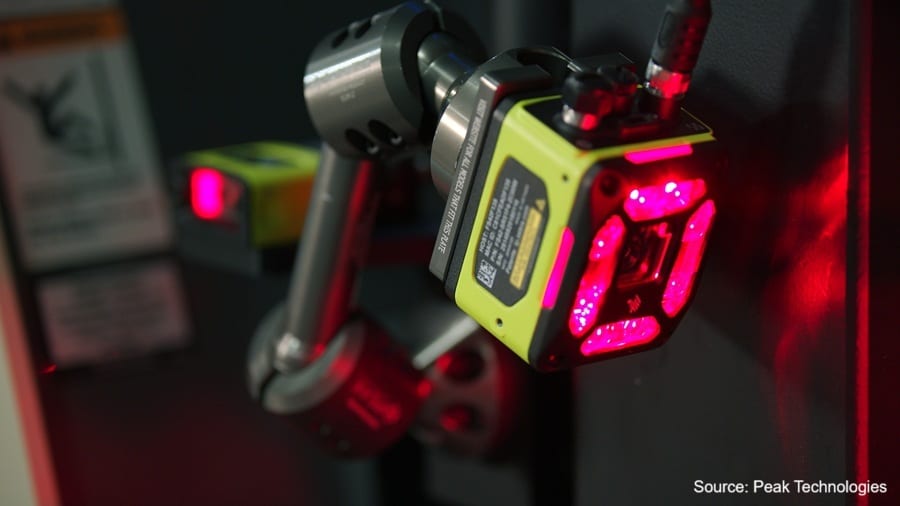
Built on advanced machine vision, smart optics, mobile computing and unified analytics, Peak Automation Intelligence provides an automated, end-to-end view of every pallet, package, material movement and dock workflow — without adding labor or slowing down operations.
“Manufacturers, warehouses and distribution centers are under unprecedented pressure to move faster, reduce errors and operate with greater transparency,” said Tony Rivers, CEO at Peak Technologies. “Peak Automation Intelligence gives them a powerful new path forward — one built on automation, AI and real-time data that drives smarter, safer and more efficient operations.”
Peak Automation Intelligence introduces a connected suite of innovations:
- Dock Door Insights automatically captures every barcode on a pallet in a single pass, eliminating manual scanning and reducing inbound/outbound bottlenecks.
- Pallet Insights uses specialized optics to read through shrink wrap for fast, touchless shipment classification — reducing rework, chargebacks and safety risks.
- Materials Movement Insights equips forklifts and workers with automated data capture, AI safety alerts and guided workflows to increase accuracy while reducing travel time and manual steps.
- Tunnel Insights provides high-speed, conveyor-integrated scanning that identifies damages, mislabels and compliance risks without slowing throughput.
At the center of the platform is peakautomationintelligence.com/analytics, which consolidates data from docks, forklifts, pallets and conveyors to give leaders a single source of truth for:
- Real‑time operational visibility
- AI-driven accuracy and risk reduction
- Insights that highlight bottlenecks and drive continuous improvement
Peak Automation Intelligence is now available to manufacturers, warehouses and distribution centers seeking to modernize their operations with AI, automation and unified visibility. To learn more, visit peakautomationintelligence.com.
Peak Technologies
www.peaktech.com
Baker Hughes’ Waygate Technologies, GE Aerospace Drive the Future of Automated Engine Maintenance
Providing a glimpse into the future of automated engine maintenance, Waygate Technologies, a Baker Hughes business and market leader in nondestructive testing (NDT) solutions for industrial inspection, and GE Aerospace announced the deployment of new, automated Menu Directed Inspection (MDI) templates for GEnx-1B and -2B engine borescope inspections that will help deliver a new level of standardization and automation to the inspection process.
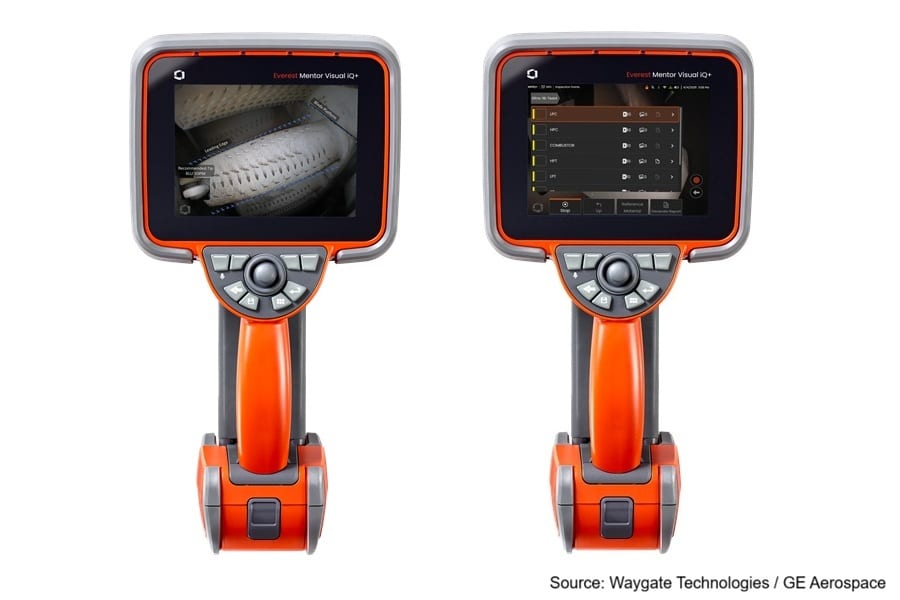
The automated MDI templates represent the latest developments through an ongoing Joint Technology Development Agreement (JTDA) between the two companies that began in 2023. The templates are being added to Waygate Technologies’ Mentor Visual iQ+ video borescope, which builds upon AI-assisted technologies previously incorporated through the JTDA to enhance the detection capabilities with commercial engine inspections.
The new templates enhance quality and efficiency by embedding guided workflows and AI assistance to help ensure consistent, high quality images during every inspection, accelerating operator proficiency and strengthening confidence in every assessment.
“We are excited to see the MDI Templates now available to our customers, providing a standardized approach to inspections and advancing the next phase of automation in engine maintenance,” said Michael Domke, General Manager Visual, Waygate Technologies. “Through our Partnership with GE Aerospace, we are combining decades of inspection expertise with AI and automation to accelerate the future of digital maintenance.”
“Together with Waygate Technologies, we’re further integrating automation and AI to help our operators drive more standardization, consistency, and efficiency with video borescope inspections for critical engine parts,” added Nicole Jenkins, Chief MRO Engineer, GE Aerospace. “These technologies are empowering our MRO workforce to work more productively, while raising the bar even higher on safety and quality.”
The MDI templates are designed to guide inspectors in achieving the recommended views for High-Pressure Turbine (HPT) S1 and S2 blades, fully aligning with aircraft maintenance manual tasks. Providing image overlays and representative images directly on the Mentor Visual iQ+ borescope screen, they ensure consistent imaging and reduce operator variability. This advancement streamlines the screening and dispositioning of blades by integrating automated and manual 3D measurement capabilities, including line, area, depth, and profile.
Key benefits of the new MDI templates include:
- Rich inspection data and traceability: Automated image and video data labeling enriches the quality and traceability of inspection results.
- Improved connectivity and workflow: Inspectors can easily transition between inspection areas and store results in real-time via the InspectionWorks Insight cloud platform by Waygate Technologies, facilitating seamless data sharing and fleet optimization.
- Workforce enablement: By providing clear visual guidance, the templates help address labor market challenges and reduce the learning curve for new technicians.
This initiative is another step on the journey to increased automation and assistance for engine inspections. Working together under the Joint Technology Development Agreement (JTDA), GE Aerospace and Waygate Technologies are looking to utilize automation to drive even greater efficiency and reliability in engine maintenance.
The GEnx Menu Directed Inspection Templates are available now via GE Aerospace Customer Technical Education Center GE Aerospace SSO. For more information, visit myGEAerospace.com or https://www.bakerhughes.com/waygate-technologies.