Products
the latest products to help you improve your manufacturing process
Onto Innovation’s 4D Technology 4Di InSpec SR System for Shop-floor Surface Roughness
Onto Innovation’s Tucson-based subsidiary 4D Technology announced the launch of the 4Di InSpec™ SR roughness measurement system - a novel, portable, vibration-immune optical system for high-precision 3D surface roughness measurement at the point of use.
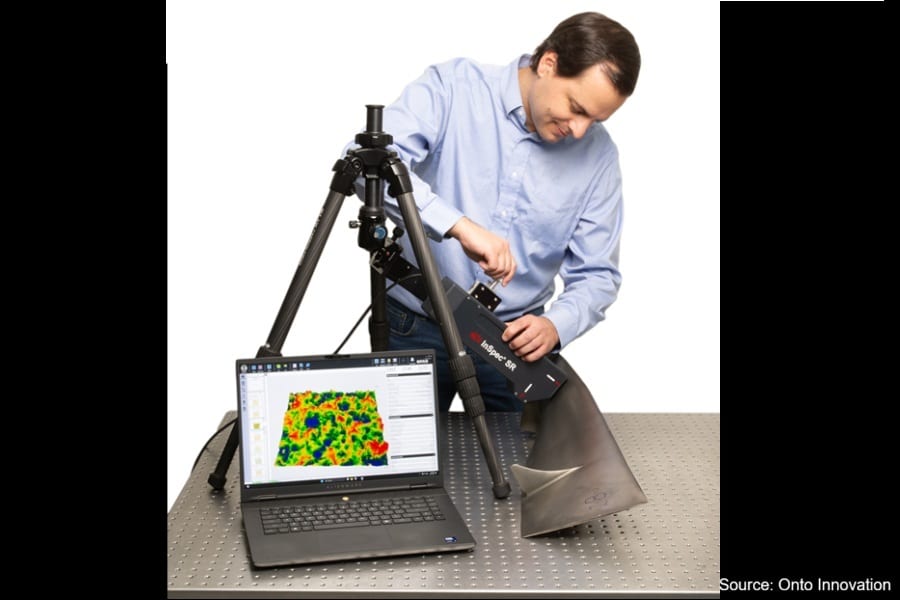
The 4Di InSpec SR transforms how precision surface measurements are achieved by enabling surface finish and roughness measurements down to 12 nm Sa in seconds, right on the shop floor. The system can directly measure roughness on large components – without the need for replication. Scratch-free optical technology eliminates surface damage, enabling measurements on most materials including carbon fiber, metals, composites, plastics and silicon.
With a roughness Sa accuracy of better than 0.5% and its small, portable form factor, the 4Di InSpec SR can measure in virtually any orientation to reach difficult-to-access locations, tight corners, and large surfaces on applications including:
- Aviation & aerospace parts such as engine rotors, turbine blades, shafts, and gears
- Medical implants
- Automotive parts including engine cylinders, cranks, bores, gears, brake pads, and EV batteries
- Precision bearings
- Shot peen surfaces
- Bare and processed semiconductor wafers
- In-situ surface finish processing (grinding, polishing, lapping) and precision machining
- Additive manufacturing
- Fillet surfaces
“This launch represents a new class of shop-floor optical surface roughness measurement technology,” said Craig Manning, VP of Onto Innovation. “By expanding our product portfolio with a portable, vibration-immune optical profiler, we’re giving customers a powerful new way to solve some of their most challenging surface roughness problems – delivering lab-quality, 3D roughness data directly on the shop floor for faster decision making.”
The system includes the robust 4Di InSpec SR software which offers an intuitive, touchscreen interface for setup, operation, analysis, and data transfer to quality control systems, and compliance with standard ISO filters and 3D roughness parameters, including S-parameters.
The 4Di InSpec SR system comes in multiple configurations, including tabletop, workstation mounted, armature-mounted, or robot-mounted for fast, automated inspection of surface quality on large and hard-to-reach components.
Onto Innovation
www.ontoinnovation.com
4D Technology
www.4dtechnology.com
General Inspection Gi-307 High-Speed 360° Fastener Inspection
General Inspection, LLC has announced the launch of the Gi-307, a powerful new fastener inspection and sorting platform designed to redefine quality control for manufacturers producing mission-critical screws and bolts.
Built for applications where failure is not an option, the Gi-307 delivers comprehensive 360-degree inspection using a revolutionary combination of sequenced front and back lighting with seven high-speed inspection cameras. Unlike conventional inspection systems that struggle to balance dimensional accuracy with reliable surface defect detection, the Gi-307 performs both simultaneously — at production speeds up to 300 parts per minute.
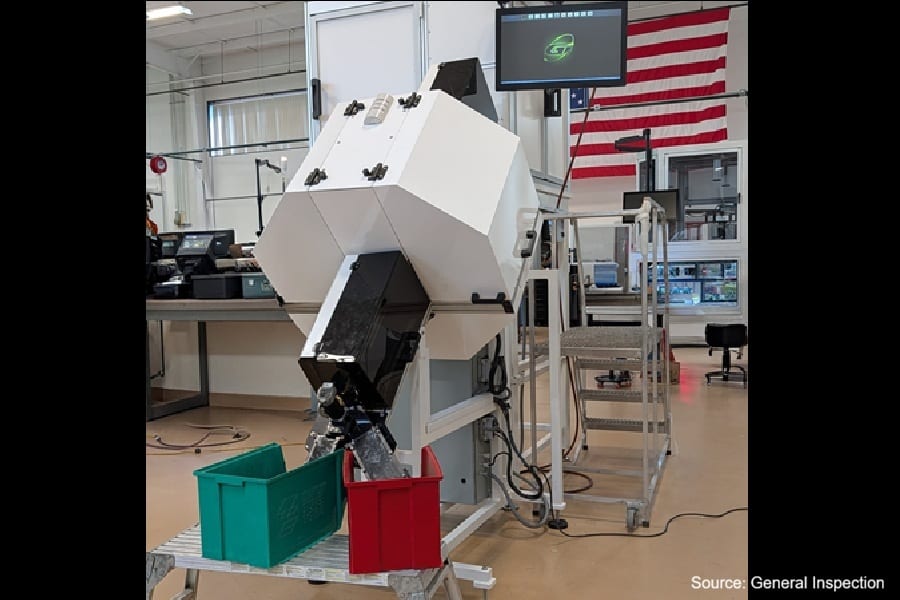
The system inspects every critical fastener feature, including threads, diameters, lengths, angles, radii, and straightness, while also detecting challenging visual defects such as cracks, plating failures, corrosion, metal chips, and porosity.
The Gi-307 also incorporates a dedicated on-axis inspection camera to analyze fastener head recesses, allowing manufacturers to detect defects and dimensional issues in slotted, Torx®, and Phillips® drive systems with exceptional precision.
For manufacturers requiring even greater process validation, optional Eddy-Current technology can verify proper heat treatment by identifying improperly hardened parts before they reach assembly or the field.
The result is a next-generation inspection platform capable of replacing multiple standalone inspection processes with a single integrated solution.
“The Gi-307 was engineered to solve one of the industry’s biggest challenges — achieving true high-speed dimensional inspection and surface defect detection in the same machine without compromise,” said Greg Nygaard, VP at General Inspection, LLC. “Manufacturers today need more than basic sorting systems. They need complete inspection confidence, especially for safety-critical fasteners used in demanding applications.”
The Gi-307 supports fastener diameters from M2 to M35 and part lengths from 10 mm to 150 mm, making it suitable for a broad range of automotive, industrial, medical, aerospace, electrical, and heavy-equipment applications.
One of the system’s current deployments involves fasteners used in electrical transformers, where component integrity directly impacts operational safety and long-term equipment reliability. In these environments, defective fasteners can contribute to loosening, overheating, internal short circuits, and catastrophic system failures.
By combining advanced optical inspection, precision metrology, recess verification, and optional metallurgical validation in one high-speed platform, the Gi-307 gives manufacturers the ability to improve process capability, and protect their reputation in zero-defect production environments.
As quality requirements continue to intensify across global manufacturing, the Gi-307 positions General Inspection at the forefront of next-generation fastener inspection technology.
JAI Wave Series SWIR Line Scan Cameras
JAI announced the expansion of its Wave Series with the introduction of two new high-performance SWIR line scan cameras: the WAL-1001-GE (1K) and WAL-2001-GE (2K). Designed for demanding industrial inspection applications, the new models combine high-sensitivity short-wave infrared imaging with a GigE Vision interface, enabling efficient data transfer and straightforward system integration.
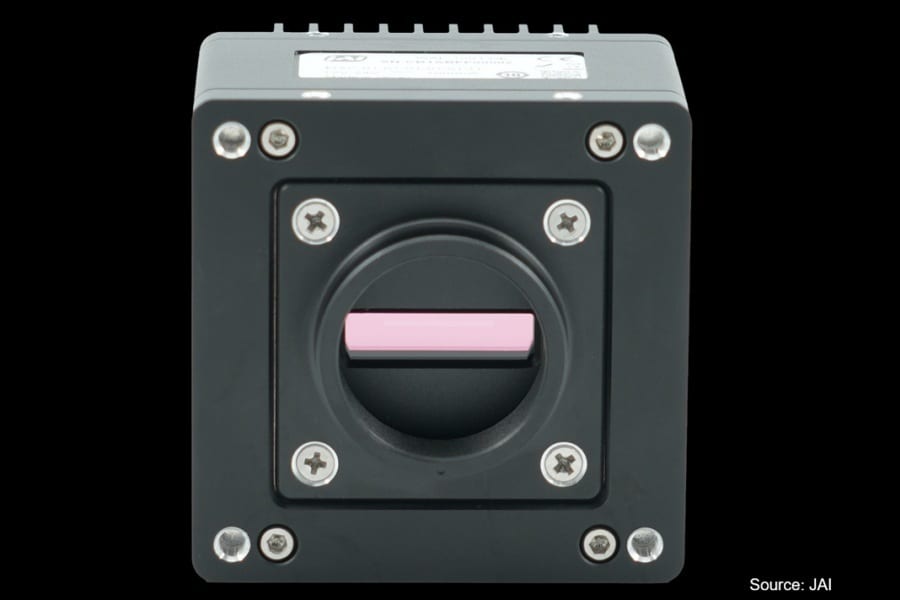
The new cameras are engineered to deliver reliable imaging performance in challenging conditions where conventional imaging falls short. With large 12.5 µm × 12.5 µm pixels, both models provide a high signal-to-noise ratio and excellent infrared response, ensuring precise detail capture even in low-light environments. A peak quantum efficiency of up to 83% further enhances sensitivity, supporting high-speed imaging without compromising image quality.
Both cameras offer flexible Mono 8-, 10-, 12-, and 14-bit output, enabling accurate intensity representation, smoother grayscale transitions, and improved measurement precision in demanding SWIR inspection tasks.
The WAL-1001-GE features a 1 × 1024-pixel sensor with a 12.8 mm sensor width, combined with large 12.5 µm square pixels, a GigE Vision interface, and a standard C-mount. Supporting line rates of up to 29 kHz (29,000 lines per second), it delivers an optimal balance of sensitivity, image quality, and throughput for a wide range of inspection systems.
The WAL-2001-GE builds on this performance with a 2K resolution output and line rates of up to 40 kHz (40,000 lines per second), enabling higher-speed inspection applications.
The camera utilizes a dual-line architecture (2 × 1024 pixels) with a 0.5-pixel offset, effectively increasing sampling density. Combined with operation at double the line rate, this results in an equivalent pixel size of 6.25 µm × 6.25 µm and nearly doubles the resolution compared to conventional 1K line scan cameras. This design enables reliable detection of sub-pixel-scale defects.
Image synthesis is performed in real time within the camera, eliminating the need for external acquisition hardware. This simplifies system architecture, reduces latency, and allows seamless upgrades from 1K to 2K resolution without changes to optics, lighting, or working distance.
The new Wave Series SWIR line scan cameras provide high-performance imaging for a wide range of machine vision applications, including:
- Food sorting and grading, enabling moisture and contamination detection, foreign material inspection, and quality assessment based on bruising, ripeness, or early mold development.
- Semiconductor wafer inspection, supporting detection of subsurface cracks, surface uniformity analysis, edge inspection, and alignment through silicon.
- Recycling and material sorting, enabling reliable identification and separation of plastics such as PET, PE, PP, and PS, including black and dark materials.
- Pharmaceutical and fill-level inspection, supporting high-speed inspection of vials, ampoules, and blister packaging with reliable fill verification.
- Plastic seal inspection, enabling reliable detection of seal defects such as bubbles, wrinkles, and improper sealing in transparent or opaque packaging systems
With a 12.8 mm sensor width, both models support standard C-mount optics, offering flexibility in lens selection and straightforward integration into existing systems. As with all JAI cameras, the new models are built using advanced low-noise designs and high-quality components, and undergo extensive thermal, shock, and vibration testing to ensure long-term reliability in industrial environments.
With the introduction of the WAL-1001-GE and WAL-2001-GE, JAI continues to expand its Wave Series portfolio, delivering flexible, high-performance SWIR imaging solutions tailored to the evolving needs of industrial vision applications.
In addition, the Wave Series will soon be extended with a new SWIR area scan camera offering 1.3 MP resolution, further broadening application possibilities.
JAI
Introducing new Wave Series SWIR line scan cameras with 1K and 2K resolution and GigE Vision interface
www.jai.com
Nikon ECLIPSE LV100AMS Automated Microscope
Nikon Corporation (Nikon) has launched the ECLIPSE LV100AMS, a new one‑click automated microscope designed to simplify industrial inspection and quality control. Built on Nikon’s established industrial microscope platforms, the LV100AMS combines fully automated inspection with AI‑powered image analysis, enabling manufacturers to improve consistency, increase inspection speed, and strengthen confidence in inspection outcomes.
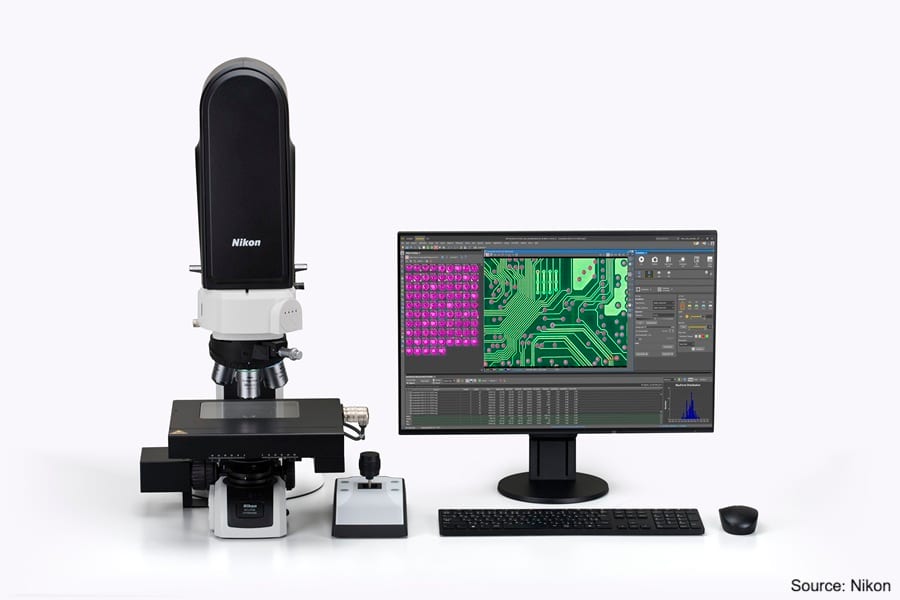
Manufacturers today face growing challenges such as labor shortages and increasing throughput demands, making consistent inspection quality difficult to maintain. To address these issues, Nikon developed the LV100AMS, automating the entire inspection workflow from image acquisition to analysis. As John Moore, Sales Director at Nikon, said: "We enable manufacturers to reduce human error, accelerate inspections, and maintain stable quality across production lines." The LV100AMS is now fully integrated into Nikon's industrial microscopy portfolio, offering a complete and reliable automated inspection solution.
Key Features and Business Impact:
- One‑Click Automated Inspection:
Why it matters: Manual inspection is highly dependent on operator skill and consistency, making it difficult to maintain stable quality at scale.
Business impact: With one‑click execution, even complex inspection routines and advanced image analysis run automatically, eliminating operator‑to‑operator variation and reducing human error. This enables repeatable, standardized inspections across shifts and sites, improving yield, lowering rework rates, and reducing training time. - Integrated Motorization, Automated Imaging, and AI‑Driven Analysis:
Why it matters: Disconnected inspection steps and manual interpretation slow down workflows and introduce variability.
Business impact: By seamlessly integrating motorized control, automated image acquisition, and AI‑powered analysis into a single system, the LV100AMS delivers consistent, objective results with minimal operator influence. This increases throughput, supports scalable inspection strategies, and provides higher confidence in quality decisions. - Customizable Automated Workflows:
Why it matters: No two production lines or inspection requirements are the same, and rigid systems limit process optimization.
Business impact: The LV100AMS allows manufacturers to design customer‑specific inspection workflows tailored to their products, processes, and inspection conditions. This flexibility enables inspection approaches that are not achievable with conventional microscopy, helping manufacturers adapt quickly to new products, design changes, and evolving quality standards. Learn how the ECLIPSE LV100AMS can transform your inspection workflows - contact Nikon today to request a demo or speak with an expert.
Teledyne AxCIS Contact Image Sensors
Teledyne DALSA announced the expansion of its AxCIS™ family of high-speed, high-resolution, fully integrated line scan imaging modules, now available in resolutions up to 1,800 dpi and lengths of up to 1,500 mm. These easy-to-use Contact Image Sensors (CIS) integrate sensors, lenses, and lighting into a single compact unit, offering a cost-effective inspection system for many demanding machine vision applications, including semiconductor wafer, battery, and print inspection.
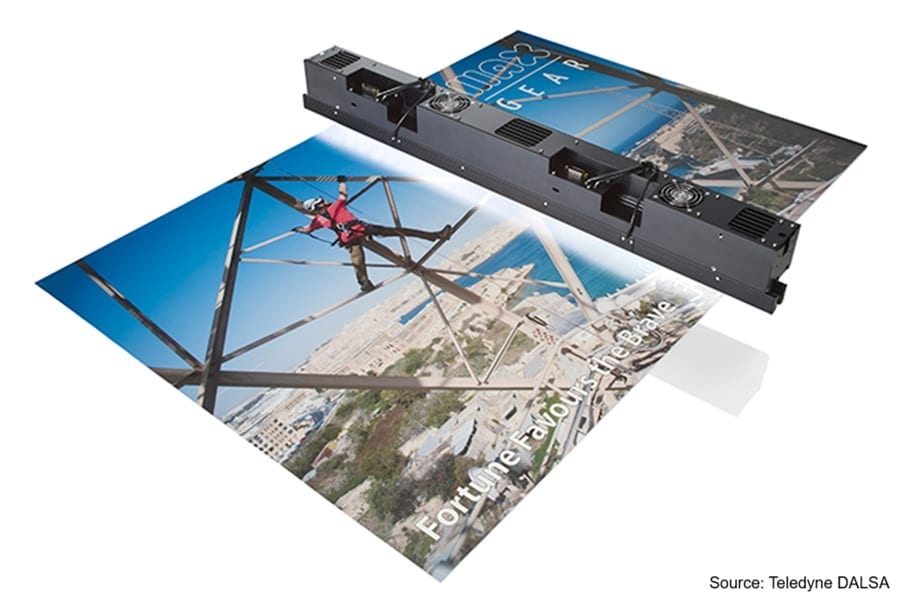
Powered by Teledyne’s multiline CMOS image sensors, AxCIS delivers exceptional image quality with monochrome line rates of up to 80 kHz at a 14 µm pixel size, or resolutions up to 1,800 dpi. For color inspection, it outputs a native RGB 3-line rate of up to 60 kHz, at a 28 µm pixel size or 900 dpi resolution, so that flaws can be identified with unprecedented precision. AxCIS also offers a unique high dynamic range (HDR) capability to further improve defect detectability. Its unique sensor design covers the entire field of view without missing pixels, providing a 100% seamless image without interpolation, and the telecentric lens supports true metrology applications.
AxCIS has been designed for scalability across various fields of view using a single 24V power supply. With a small form factor and an IP60 dust proof optical path, AxCIS provides the flexibility to fit into systems with limited vertical clearance. Its SFP+ fibreoptic interface delivers high throughput data over standard low-cost, long-length cables with immunity to EMI radiation for harsh industrial environments.
Teledyne Vision Solutions
https://www.teledynevisionsolutions.com/
Nikon NEXIV VMF-K6561 Measuring System
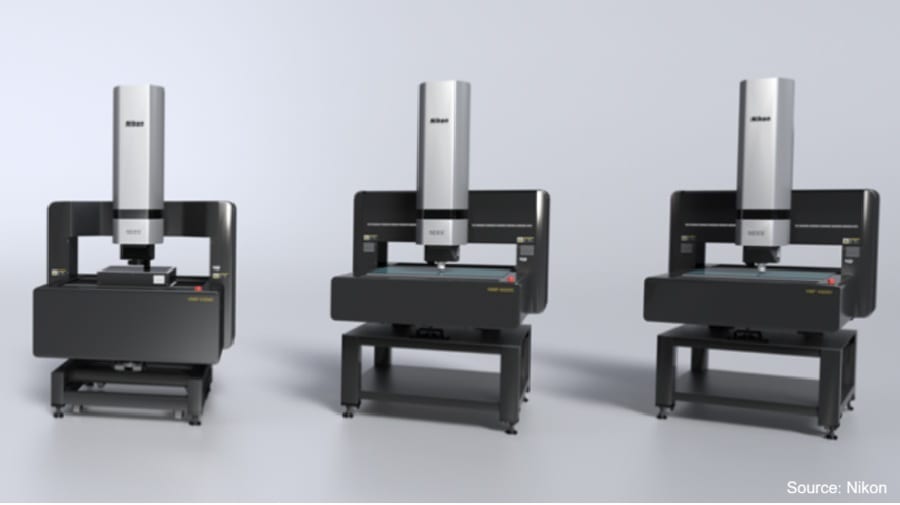
Nikon Corporation (Nikon) has launched the NEXIV VMF-K6561, the latest addition to its NEXIV 3D Confocal series. Building upon the proven technology of the NEXIV VMF-K series, the NEXIV VMF-K6561 features a 650×610 mm stage capable of measuring an entire large-format 600×600 mm panel in a single setup. This enables full-panel measurement of panel-level packages using Nikon's high-speed measurement technology.
Key Feature:
- Equipped with a Large Stage:
To accommodate 600×600 mm panels, the NEXIV VMF-K6561 is equipped with a 650×610 mm stage. The full-panel measurement eliminates production backlogs and shortens measurement times. Furthermore, the larger stage features an increased stage glass thickness, ensuring stable measurements.
Nikon Metrology, LLC – Americas
https://industry.nikon.com/en-us/products/video-measuring-systems/nexiv-vmf-k-series/